
Last year I wrote a blog about working as a Widening Participation Ambassador, helping out when school groups visit the university. These days are designed to help young people-from primary school age all the way up to the end of sixth form/college- decide whether they think university might be somewhere they’d like to go. We run subject-specific days and also general higher education taster days. Both of these involve campus tours, question-and-answer sessions with ambassadors about how they came to be at uni and how they gained places on their particular courses, and other hands-on activities.
There is also the opportunity for ambassadors to run subject-specific workshops, so that visitors may gain a little more insight into what a subject is like to study. Many of the courses on offer at City-including speech and language- are vocational, meaning that you’re qualified for a particular job once you graduate (not the case for my drama degree…clearly….). So, when I was asked to plan and run one of these workshops as part of a health taster week, I wanted to focus on different aspects of the SLT role, because, quite frankly, lots of people have no idea what we do. So, I thought I’d say yes immediately and then worry about what I was actually going to do later.
Thus the workshop was born. For the first part, students play around with different thickeners and learn a little bit about swallowing difficulties, watch some videofluroscopy videos (an x-ray of a swallow- see the rather weird-looking 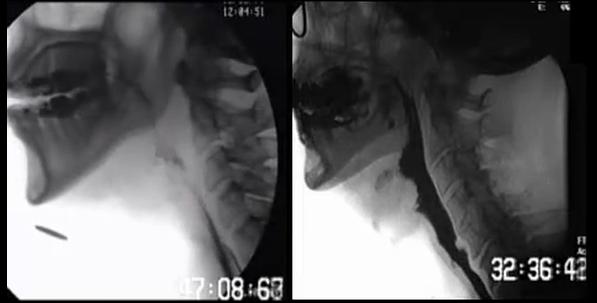 picture) and reflect on some of the difficulties associated with prescribing thickener for a client. The second part is focussed on adults with aphasia (see the blog about volunteering at Roberta Williams Centre). Participants get to design a new area of a virtual world called EVA Park, which is the brainchild of City staff. It’s a place where adults with aphasia get to practise everyday conversation. They’ve got to think about places that the users would want to visit and that would also promote functional communication. Existing places include a hairdresser, a café and a doctors’ surgery. Ideas that have come from the workshops have included a gallery, an allotment and an airport. It is highly likely that this description of EVA really does not do it justice, so here’s a link to a video that explains it much better:
https://www.youtube.com/watch?v=ouF1Nwvo6js
So, the workshops. The first one was…alright. The second, third, fourth and ongoing ones have been much better. It’s been amazing to not only see students learn things about SLT that they really had no idea about before, but also to see how sensitively they deal with potentially difficult subjects. I’ve been able to use it for primary and secondary school students, and spread the word about SLT and the great work we can do as therapists. It’s also been brilliant practise for presenting and training, as this is something that will almost certainly be part of my job role. And- quite wonderfully-for me, there is nothing quite like talking about my future job to make me feel incredibly enthusiastic and excited about it.
If you would like to learn more about studying Speech and Language Therapy at City, you can visit the course page here.


Leave a Reply