
Are We Open Yet? Is the Use of Rights Retention Strategy the Open Access Breakthrough We are Looking for.

Black and white image of womanThis blog post is written by Ami Pendergrass who is a MSc student in Library and Information Science at City and recently completed my module EDM122. Her essay is on the introduction of Rights Retention Strategies to Open Access in Higher Education.  She writes……

As a current Library and Information Science (LIS) Student, I am learning of the importance of how my colleagues and I need to be at the forefront of determining the future of our library services.  One of the key topics of discussion is Open Access (OA).  OA is the mechanism that makes research publications freely available, free of charge, and free from most copyright restrictions to anyone who can benefit from them (see JISC, 2019; City, 2023a; Creative Commons, 2024).  In simple terms, OA is the way to bring the depth of research and analysis out from behind (mostly expensive) paywalls and share it.  This benefits not only fellow researchers who can learn and build from it, but the public at large, where people can use it to create new ideas, change opinions or even save lives.

In the case of higher education (HE), one of the challenges of OA, however, has been in finding a long-lasting working relationship and strategy between HE, authors, and academic publishers that simultaneously provides that kind of necessary access while also mitigating the significant impact it will have on publishers and publishing models (Moskovkin et al., 2022, p. 176; SPARC Europe, 2023).  An area of keen interest to me as both a LIS student and a former lawyer and negotiator is the recent adaptation of a Rights Retention Strategy or RRS by HE institutions in the UK as a tool to force OA quicker.  RRS is a process that uses Creative Commons licensing to assign copyright, giving a way for authors to ensure that they can deposit their work where they see fit including OA which is still being limited by many academic publishers.

As someone who plans on working in this space as a librarian, understanding this issue for myself and for my users is critical.  Below, I will discuss the background of OA and how HE institutions have moved to RRS as a tactic to bring OA quicker.  I will then provide my views on RRS as a strategy and what we as librarians can be doing to help support our users in manoeuvring through this potentially complicated process.

A Brief History of OA and Transformative Agreements

Before we can talk about what rights retention strategy (RRS) is, it helps to understand where we’ve been.  OA itself was born at the cross-section of several big issues.  First, a large portion of important research projects are publicly funded.  However, with the shift of published academic research from print to digital, much of that publicly funded research came to be behind paywalls, which made access to it by other researchers (and sometimes even the authors themselves) difficult and expensive (see City 2023a; REF, 2023; Plan S, 2021).  This would mean that research may never be acted upon or could be duplicated (Moskovkin et al., 2022, p. 176).  And as became immediately apparent with COVID19, resolving complicated, international issues meant needing access to the latest research quickly and cost-effectively to save lives (Moskovkin et al., 2022, p. 176; SPARC Europe, 2023).  Many funders, including COAlition S and UK Research and Innovation, now require OA publication as a result (Plan S, 2021; REF, 2023; City 2023a; City 2023b).  Second, HE institutions and libraries were dealing with the clash between an astronomical rise of subscription journal prices (with one statistic showing an eightfold increase in costs from 1984 to 2010) and shrinking budgets that put pressure to bring those costs down (Borrego et al., 2021, p. 216).  A transition to OA was seen as the solution to both problems.

To find a ‘middle ground’, HE institutions and academic publishers (who were not already OA) negotiated an arrangement called a transformative agreement (TA’s) to help those publishers who were closed access (or whose material was behind a subscription paywall) to ‘transform’ from subscription to fully OA (see City 2023a; REF, 2023; Plan S, 2021).  TAs have developed into three main types:

  • Pre-transformative – this is where the journal would still have a paywall but would allow a limited number of articles to be published OA, usually by using a discount or voucher system to track.
  • Partially-transformative – this is where the journal would offer two types of fees, a ‘read’ fee or the normal subscription fee and a ‘publish’ fee or what is referred to as an article processing fee or APC to publish OA (and these too are usually limited in number).
  • Fully-transformative – this is where the journal would provide a single fee for both subscription and APC and this would allow for unlimited OA publication.

(Borrego et al., 2021, p. 216).  These types of TAs (above) created in many cases a new type of journal, the ‘hybrid’ journal, where the journal was partially OA and partially subscription.  These hybrid journals created two main routes to OA publishing: green access (which while free, can subject the author/institution to a publisher embargo period or a limitation on the number of articles that are eligible for OA publication); or gold access (which has no limits (such as embargos) but is a ‘pay to publish’ model where APCs are required) (City 2023a; City, 2023b).

TA’s, and the hybrid journals created as a result, were initially viewed as a temporary solution to promote an orderly transition from the historic subscription model to OA.   However, the transition has been slow, expensive, and not exactly temporary (Borrego et al., 2021, pp. 219, 226; Plan S, 2021; Moskovkin et al., 2022, p. 169).  An example of this can be seen with the lack of impact of article processing costs (APC) driving down the costs of overall fees.  APCs were to provide a transitional fee arrangement that shifted the cost from subscription to publishing so that works could be published OA sooner rather than later (Asai, 2023, p. 5166).  The idea was that the ‘fees’ would be constant while OA publishing would increase, ultimately resulting in subscription fees decreasing and being replaced by APC (Asai, 2023, p. 5166).  However, as multiple studies show (Asai, 2023; Borrego et al., 2021; Moskovkin et al., 2022) these fee arrangements effectively functioned as a ‘double dip’ for publishers, requiring universities to pay to publish while simultaneously paying again a subscription fee (which seemed to be ever increasing) to access the same article.   Far from being cost neutral, hybrid journals were increasing costs (see Moskovkin et al., 2022, p. 167; Parmhed and Säll, 2023, p. 6).

Enter Rights Retention Strategy

As it became apparent that transformative agreements were becoming more transfixed, HE institutions began to look for new solutions to promote OA publication, while addressing the continued increase in costs.  One of those ‘solutions’ is the adaptation of rights retention strategies (RRS).  Under most academic institution’s RRS policies, authors are asked to declare a Creative Commons license called a CC BY in the acknowledgement and cover letter of the authors accepted manuscript, prior to submission to a journal (City, 2023a; City, 2023b: Rumsey, 2022; UCL 2021).   A CC BY license enables a work to be re-used, distributed, remixed, adapted, and build upon by anyone, so long as it includes attribution to the author (Creative Commons, 2019).  The upfront notice to publishers plus the adaptation of the CC BY license, in essence, should mean that the author is free to distribute their work openly and that the publisher cannot override assignment through a subsequent agreement (UCL, 2021; Plan S, 2024).

So, why this tactic?  It could be argued that RRS was born out of an old problem.  One aspect of the old subscription model was the assignment of full copyright to publishers (exclusivity) as pre-condition for publication, which had significant impact in not only stripping authors from their intellectual property but also financial implications in locking HE institutions into having to pay for a subscription for the same authors to access their own material, ‘arguably a form of academic exploitation’ (Rumsey, 2022).  RRS is a pushback against publishers requiring authors to agree to exclusivity by allowing authors to retain their copyright using Creative Commons licensing, with the goal of immediate publication without embargo and bypassing APCs (Plan S, 2020; City, 2023a, Rumsey, 2022; n8 Research Partnership, 2023; Moore, 2023, p. 1).  RRS restores control to the author on ‘when, how and to whom research findings are disseminated’, maintaining ownership where it belongs, with the author and not a third-party provider (Rumsey 2022).  RRS is not new; universities, such as Harvard (the original RRS model) have had an RRS policy since 2008 (Rumsey, 2022; Moore, 2023, p.3).

Is RRS the ‘Opening’ We Need and How can Libraries Support ? 

As with any new ‘thing’, there are positives and negatives.  RRS can have a positive impact in not only speeding up OA publication but by serving as an effective wedge issue to gather the HE institutions and publishers back to the table to find a better way to bring balance between reasonable access and reasonable compensation (Moore, 2023, p. 7).  However, RRS is not without problems.  Rightly or wrongly, many publishers are viewing the move to RRS as a direct violation of their service agreements and that has placed authors in a difficult situation between the publishers who do not support it and the funders who are increasingly demanding it (Khoo, 2021).   The recent Cambridge and Edinburgh pilot study of RRS provides a good example of the ‘trouble’ authors are facing.  In response to the uptick in the use of RRS, the studies found that publishers have increased desk rejections; rerouted works to OA or less prestigious journals; provided incorrect or misleading advice; presented fees at the last minute; or coerced authors into signing their copyright away anyway ( Khoo, 2021, p. 3; Rumsey 2022; University of Cambridge, 2022; Open Scholarship, 2022).  However, the fight is really between HE institutions, the funders, and the publishers who, like it or not, do have a legitimate (though overpriced) function to deliver, not the authors themselves.  Asking the author to ‘hold the line’ is a bit akin to asking the child of two warring parents in a divorce to provide the solution to all the family’s marital woes (see Khoo, 2021 and Moore, 2023).

As a future librarian on the ground (and hopefully at the table), I offer a few suggestions.  First, from the bargaining standpoint (and my old lawyer days), RRS is a great starting point but, arguably, what RRS is doing is using copyright to bypass aspects of these TAs that HE institutions do not like. This is a blunt instrument that in the long term may damage our relationship with publishers.  What we ultimately need is better agreements that align charges to actual delivery by publishers (see Borrego et al.,2021; Khoo, 2021; SPARC Europe, 2023; Moskovkin et al., 2022).  So RRS is a means, not an end.  HE institutions should endeavour, as soon as possible, to work together to get back to the table and use RRS as a wedge to promote agreement on a better vision and longer-term future for both.  We ultimately still need each other and we only get there by talking.

However, talks and negotiations take enormous time and effort.  As a librarian, to support our users now, the quickest and most valuable thing we can do is to provide in-depth training on copyright that helps users understand their rights and how to tactically use their assignment in copyright to get the deal they want.  I believe anytime we ask someone to assign a legal right away, we should support them to the fullest with education and tactics so that they can make educated and sound decisions, whether they use Creative Commons or sign an exclusivity agreement.  We should also partner with our HE librarian counterparts across UK institutions to study RRS best practices, not only from the standpoint of how we manage RRS as librarians but also to help our users to understand what works and what does not as they interact with publishers.  RRS policies by themselves is not enough to really support our authors.  Training and best practice guidance is vital to make this work.

RRS may not be the opening we hoped for but it is a wedge in the door to a better future.  I believe as a librarian, our biggest contribution is to help educate and advocate for what RRS is ultimately trying to achieve, a long-lasting partnership with our publishers for an OA future.


This article is published with a CC BY license that enables re-users to distribute, remix, adapt, and build upon the material in any medium or format, so long as attribution is given to the author.  This license is for commercial use only.  For mor information, see: https://creativecommons.org/licenses/by/4.0/


Works Cited:

Asai, S. (2023) “Does double dipping occur? The case of Wiley’s hybrid journals”, Scientometrics, 128(9) pp. 5159-5168.  Available at: https://www.doi.org/10.1007/s11192-023-04800-8 (Accessed: 13/01/2024).

Borrego, Á, Anglada, L., and Abadal, E. (2021) “Transformative agreements: Do they pave the way to open access?”, Learned publishing,  34(2), pp. 216-232.  Available at: https://www.doi.org/10.1002/leap.1347 (Accessed: 13/01/2024).

City, University of London (2023a) Understanding Open Access.  Available at:  https://libguides.city.ac.uk/understanding-oa (Accessed: 11/01/2024).

City, University of London (2023b) Open Access Policy.  Available at:  https://libraryservices.city.ac.uk/about/policies/compliance/open-access-policy (Accessed: 12/01/2024).

Creative Commons (2019) About CC Licenses.  Available at: https://www.creativecommons.org/share-your-work/cclicenses/ (Accessed: 11/01/2024).

Creative Commons (2024) Open Access. Available at:  https://www.creativecommons.org/about/open-access/ (Accessed: 12/01/2024).

JISC (2019) An Introduction to Open Access.  Available at: https://www.jisc.ac.uk/guides/an-introduction-to-open-access (Accessed: 12/01/2024).

Khoo, S.Y. (2021) “The Plan S Rights Retention Strategy is an administrative and legal burden, not a sustainable open access solution”, Insights, the UKSG journal,  34(1).

Moore, S.A. (2023) “The Politics of Rights Retention”, Publications (Basel), 11(2) pp. 28.  Available at: https://www.doi.org/10.3390/publications11020028 (Accessed: 13/01/2024).

Moskovkin, V.M., Saprykina, T.V., and Boichuk, I.V. (2022) “Transformative agreements in the development of open access”, Journal of Electronic Resources Librarianship, (34) 3, pp. 165-207.  Available at: https://www.doi.org/10-1080-1941126X.2022.20999000 (Accessed: 13/01/2024).

N8 Research Partnership (2023) Why Northern Universities are Taking a Stand on Rights Retention. Available at: n8research.org.uk/why-northern-universities-are taking-astand-on-rights-retention/ (Accessed: 11/01/2024).

Open Scholarship (2022) Rights Retention Policy: An Update after 9 months. Available at: https://libraryblogs.is.ed.ac.uk/openscholarship/2022/10/14/rights-retention-policy-an-update-after-9-months/ (Accessed: 12/01/2024).

Parmhed, S. & Säll, J. (2023) “Transformative agreements and their practical impact: a librarian perspective”, Insights, the UKSG journal, 36(12).  Available at: https://www.doi.org/10.1629/uksg.612 (Accessed: 13/01/2024).

Plan S (2020) cOALition S develops “Rights Retentions Strategy” to safeguard researchers’ intellectual ownership rights and suppress unreasonable embargo periods.  Available at:  coalition-s.org/coalition-s-develops-rights-retention-strategy/ (Accessed:  09/01/2024).

Plan S (2021) Principles and Implementation.  Available at: https://www.coalition-s.org/addendum-to-the-coalition-s-guidance-on-the-implementation-of-plan-s/principles-and-implementation/ (Accessed: 13/01/2024).

Plan S (2024) Plan S Rights Retention Strategy.  Available at: https://www.coalition-s.org/rights-retention-strategy/ (Accessed: 12/01/2024).

REF (2023) REF2021: Overview of open access policy and guidance.  Available at: https://archive.ref.ac.uk/media/1228/open_access_summary_v1_0.pdf (Accessed: 12/01/2024).

Rumsey, S. (2022) Reviewing the Rights Retentions Strategy – a Pathway to Wider Open Access? Available at: https://blogs.lse.ac.uk/impactofsocialsciences/2022/10/26/reviewing-the-rights-retention-strategy-a-pathway-to-wider-open-access (Accessed: 23 January 2023).

SPARC Europe (2023) Opening Knowledge: Retaining Rights and Open Licensing in Europe 2023. Available at: https://www.knowledgerights21.org/reports/opening-knowledge-retaining-rights-and-open-licensing-in-europe-2023/ (Accessed: 13/01/2024).

UCL (2021) Wellcome, transformative agreements and rights retention.  Available at: blogs.ucl.ac.uk/open-access/2021/03/05/wellcom-transformative-agreements-and-rights-retention/ (Accessed: 12/01/2024).

University of Cambridge (2022) Rights Retention: Publisher Responses to the University’s Pilot.  Available at: https://unlockingresearch-blog.lib.cam.ac.uk/?p=3361 (Accessed: 13/01/2024).

Directing teaching staff towards free, openly-licensed, easily-accessed graphics and audio to enhance their educational resources

This post was written by Emma Guilbert as part of the final assignment for the module EDM122 at City, University of London.

As an assistant educational technologist with a focus on multimedia, I aim to teach and encourage teaching staff (referred to throughout simply as “staff”) to incorporate audio and video resources into their teaching. In this area, my job comes with two main tasks:

  1. Providing staff with the skillset and confidence required to create, edit and deliver their media to their students
    2. Directing staff towards free, openly-licensed, easily-accessed graphics and audio to enhance their open educational resources

This essay is focussing on the second task (my video assignment for EDM122 focussed on the first).

In an age where over 1bn hours of video were viewed on YouTube each day in 2023 (GMI-Blogger, 2023), and the average podcast listener consumed 6.5hrs of episodes per week in 2022 (RAJAR, 2022), it’s vital that staff are meeting their students’ expectations when it comes to engaging resources

A recent study on videos and their effect on student engagement (French, Ravn, Balcaite, & Moore, 2023) showed that 75% of students who enjoyed their chosen subject found “short weekly videos engaging”.  This may not be particularly surprising in a group who already found their subject compelling, but this pattern was still seen to be applicable to the 28% of students who did not feel engaged with the subject topic itself yet enjoyed and connected with the video resources. This is further supported by research that videos, screencasts and podcasts all reduce student drop-off rates (Angelino, Williams, & Natvig, 2007)

As a result, I aim to encourage staff in upscaling their non-multimedia resources into something more engaging to their students.

One suggestion I give staff is to review any revision materials they provide and potentially convert them into transcribed podcasts. Gunderson & Cumming (2023) found that “podcasts may best be used to extend, enrich or enhance knowledge”. Therefore if a traditional resource is a typed transcription of a conversation between a staff member and a visiting lecturer, students may find it far more engaging to hear the original conversation as a recording and using the typed transcription as a supplementary accessible resource.

Alternatively, converting their roughly scanned supporting documents for lectures into something easier to navigate and digest (such as a series of bite-sized, captioned videos) can help students not only connect better with the material but also with the presenting staff member. (French, Ravn, Balcaite, & Moore, 2023)

Or, as a final option, staff can keep their original resources and, going forward, supplement them with new pieces of multimedia.

When carrying out this move towards multimedia, it’s important that the visual content accurately represents the spoken content and any audio has high production values (eg good quality music, clear spoken tracks and suitable effects). These help resources look and sound more professional, reflecting the time and effort put into creating them.

Ideally this multimedia – and any outsourced content used within them, such as music and graphics (referred to as “elements”) – would also be openly licensed, allowing for staff to use and credit them with confidence, as well as distribute them amongst the teaching community for reuse.

In relation to elements used for educational resources, open licensing refers to them residing “in the public domain or are under copyright that have been released under an open license, that permit no-cost access, re-use, re-purpose, adaptation and redistribution by others.” (Open Educational Resources, 2021)

By including openly licensed elements in their multimedia resources, staff are reassured that they have the legal rights to be using them (particularly when updating and distributing their resources over the years, or sharing amongst academics for reuse), and are often able to edit the base media to better suit their needs. It also highlights to students that openly licensed resources can be professional looking and easy to create in their own work.

Top view of 3 metal gears isolated on a white background. Gears would not successfully rotate if activated.

From Adobe Stock, under their Educational License

When I first looked for a graphic of gears to use in a video I created, I headed straight to Adobe’s Stock repository. This provides high quality elements for use under their Educational License. However, despite Adobe being a multi-billion dollar company (Adobe, 2023), its search function immediately provided multiple images of a set of gears which were impossible: as above, they simply would not turn in reality.

Unsplash.com, a popular and free stock image site, returned an equally impossible search result. Unsplash has also historically had a seemingly complex relationship with Creative Commons licensing, referenced in a post on the Creative Commons site (Merkley, 2017), however for educational purposes it would unlikely ever be an issue.

That isn’t to say that images of workable gears weren’t available, but it did require additional effort on my part in order to find them.

Whilst this may seem like a small issue, it highlights how staff, particularly those in STEM or requiring technically oriented elements, must often dig down through pages of search results to find accurate and useful options. Time is sacrosanct for a lot of staff and “many teachers lack confidence in using multimedia technology” (Means & Simkins, 2000) which they would use to create new resources. They then don’t want to also go hunting for every element, particularly if the status quo is ultimately achieving the same outcome: providing a resource for their students, even if they’re visually outdated.

On top of this, diversity in educational resources is essential and all too often entirely overlooked. We, as educators, are not one homogenous group and neither are our students. The resources we create should therefore reflect this. Finding materials that reflect diversity in gender, race, culture, sexuality and more is key to ensuring that otherwise-engaging multimedia resources don’t immediately alienate a large percentage of students because they are under-represented or missing entirely. By creating our own resources, or adapting openly licensed elements, we can help represent a larger audience.

Staff also need to be aware of excessive use of elements, particularly ones which may be inaccessible due to complexity, or simply there for decoration or an audio flourish. They must navigate the fine line between engaging content and ensuring accessibility for all students, always including those with varying learning requirements.

Finally, when staff come up against open licensing terms such as “BY-SA”, “non-commercial” or “ShareAlike”, the various options, abbreviations, exceptions and more may hinder their ability to appropriately integrate, modify and acknowledge the openly licensed and OER content they use.

Ultimately it’s my job to empower staff to overcome those hurdles and I feel as though the primary way to do this is via imitable examples which demonstrate to staff best practices and ideal outputs.

Asking staff to spirit up an idea of an engaging yet accessible podcast, or how to go from a raw narrated screencast to a gently yet effectively edited video resource, is difficult if they have never encountered one before. If staff are dissuaded because they do not have any references for effective resources, we have killed their creativity and drive before they have even begun.

EDM122 has made me realise that these example resources may not yet exist for many staff, and I am well placed within both LEaD and as someone who helps run City’s MILL service to both create and promote them as stock pieces for inspiration. Explaining how musical opening themes might drown out speech tracks in a podcast, or how busy and bright backgrounds can visually drown out objects in the foreground of a video, may well be concepts which staff had not considered before but would vastly improve their multimedia resources.

It’s also crucial to introduce staff to (and educate them about) the various online platforms and repositories which can help with their resource creation, as well as their limitations. Places such as the Creative Commons site work not only as information hubs on licensing but also as a search engine for openly licensed visual and audio elements. It also has a specific Licence Chooser, allowing users to work through a series of questions to find the best CC licence for their work. Flickr allows users to search for Creative Commons-specific elements.

Canva, specifically created to provide an easy in-road for users not otherwise au fait with graphic design software, has proven anecdotally popular with staff who can quickly create aesthetically pleasing images. Whilst Canva does provide a range of images on its site which can subsequently be licensed under Creative Commons, there are also some which require additional fees for usage commercially, making using the site a double-edged sword.

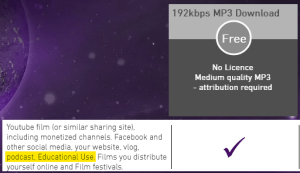
For audio resources, whilst the Creative Commons search engine can successfully direct you to a variety of openly-licensed elements, users often need to check sites (and sometimes specific tracks) carefully to ensure that they are covered to use any audio in podcasts as well as videos. This is often down to the incidental nature that audio can take in videos (as the primary medium is visual) whereas in podcasts the audio can become inextricably linked to the identity of the content.

The licensing section of PurplePlanet, highlighting
the inclusion of podcasts in their free use policy.

It is also not well-advertised within City that staff have access to Adobe’s Stock repository, within which many elements are included either under Creative Commons licensing or Adobe’s Educational Licence. However, as mentioned above, it may still require a certain amount of digging on all of these sites to find specific elements which match all requirements.

I think it’s also necessary to ensure that staff are aware of City’s dedicated copyright librarian (Stephen Penton) and the City LibGuides Copyright microsite dedicated entirely to helping all university users (students and staff) navigate crediting, licensing and more. This is something I was not originally aware of when I first started and now use as a “cheat sheet” guide whenever I am creating a new piece of media.

It’s vital that we encourage staff to both get in touch and stay in touch with LEaD and the library when it comes to creating openly-licensed multimedia resources. I want to help establish and foster  a collaborative and supportive environment amongst staff where no multimedia question is bad; where staff can stay up to date with changes in both copyright law and the latest mod-cons when it comes to creating, adapting and distributing resources; where staff can be proud of the multimedia resources they have worked on, and confident in distributing them to a wider audience thanks to their openly licensed elements.

The more we are able to create accessible, diverse, high quality multimedia resources which can be shared on a local and global scale, the more we broaden the size of our open, collaborative, educational community.

I have chosen to attribute the CC BY-NC-SA licence to this work. Ultimately this means that:

“re-users give credit to the creator. It allows re-users to distribute, remix, adapt, and build upon the material in any medium or format, for non-commercial purposes only. If others modify or adapt the material, they must license the modified material under identical terms.” (Creative Commons, 2024)

I chose this option as I am happy for others to use my work to build their own pieces, however I want them to continue in the spirit of Creative Commons’ ShareAlike licensing so that others can build on their work.

Directing teaching staff towards free, openly-licensed, easily-accessed graphics and audio to enhance their educational resources © 2024 by Emma Guilbert is licensed under Attribution-NonCommercial-ShareAlike 4.0 International 

Evidence Based Practice and Open Access

This Photo by Nick Shockey is licensed under CC BY-SA

This post was written by Ravi Ladani as part of the final assignment for the module EDM122 at City, University of London

Evidence based practice (EBP) is a foundational cornerstone in my working life as an optometrist, as it is for all healthcare practitioners. In my role as a lecturer, it is a skill I (and my colleagues) teach, as well as it influencing the content that I teach. When learning about open practices, I was intrigued by the impact that open access could have on EBP, not only in optometry but in healthcare as a whole.

What is EBP and open access?

Evidence-based practice (EBP) in healthcare involves the combination of clinical expertise, patient’s values, and the best evidence to inform clinical decision making to provide the best clinical outcome or management for a patient1. Fundamental elements to employ best evidence are the ability to search and synthesise information, but importantly how available is the best information, i.e. is it accessible2.

Open access is defined by the Joint Information Committee Systems (JISC) as “making research publications freely available so anyone can benefit from reading and using research”3.

So why is open access important for EBP?

It is useful to consider what we mean by “best” and “available” evidence. Traditionally, knowledge has been imparted via textbooks and lectures. However, these mediums are quickly outdated4. They are still valuable tools to provide theoretical and foundational knowledge, but do not provide the most recent knowledge, and therefore not the best knowledge.

Research articles allow the most up to date research to be published, which is a vital step to EBP5, but this leads to the consideration of access. When I now reflect on how I have accessed research in my career to date, there are two distinct time periods. Since becoming a lecturer, I have had the privilege of accessing a large range of articles and databases via an institutional login.

Studies have shown that most peer-reviewed research has traditionally been published in subscription based journals6, and that having institutional access allows access to 75% of articles that would not otherwise be available unless one was willing to pay for them7. The reason for this is due to the extreme costs associated with subscription8.

Healthcare practitioners that do not have access via an institution, as was the case for myself earlier in my career, are faced with theses subscription costs or paywalls6. Subscription costs are unfortunately expensive, Furthermore, should the article not actually be what the practitioner was after, refunds cannot be requested5.

To me, this highlighted some obstacles to EBP. Firstly, by holding information behind a fee, the availability of the “best” research is reduced, therefore limiting the pool of evidence that a practitioner would ideally need to make the best clinical decision. An article published in the British Medical Journal (BMJ) showed that open access publications received 89% more full-text downloads, 42% more PDF downloads and 23% more unique visitors9, highlighting the link between open access and availability. This issue is exacerbated for practitioners in low income countries. However, many publications will be made accessible to countries in low income countries, but raises the question of how well known it is.

Secondly, students benefit from institutional access whilst studying at university. We teach students how to access the information, how to reinforce there studies with the latest research, and how to use this research and evidence to inform their clinical decision making. Once a student has left education, they have lost a significant amount of resource, and their knowledge as a result can potentially become quickly outdated too.

Thirdly, an element of EBP is the patient’s values and decisions. Some patients may choose to search for evidence themselves. They face the same issues that healthcare practitioners have with access, but they also potentially could be faced with another problem. Should the practitioner have access to more recent research than the patient, the patient maybe conflicted with what information to use. However, should all evidence be open access, patients and practitioners will have access to the same information and therefore patients will have more confidence in the evidence (as they can find it themselves should they wish).

However, publishing an open access article does not guarantee the reader will have addressed the availability issues completely. JISC highlights two types of open access publishing: Gold and Green open access3.

Gold access allows the fully published article to be immediately available without the requirement of a fee or subscription by the viewer. This allows the latest research to be made available immediately, but there is an article processing fee (APC) instead that the researcher must pay which can be expensive and therefore a potential barrier.

Green open access involves fully published articles being made available under a subscription based model, but also allows accepted manuscripts to be uploaded or self-archived in a repository. This can involve an embargo, that once expired allows the fully published article to be made freely available. This has the advantage of not involving an APC. The disadvantage it has is that repositories can be less discoverable, and therefore if an embargo is in place, it limits the availability of the article until the embargo has ended. This means that as healthcare professionals, it is important that we are equipped with the digital literacy skills to find these studies on resources such as Google Scholar, and as educators we provide our students with the required skills.

The BMJ also identifies another model – “Diamond” or “Platinum”10. This involves fully published articles being made immediately available without a direct publishing fee. This would allow the most recent evidence to be most freely available and therefore has the potential to be most useful to EBP.

Another factor to consider with open access and EBP, is what else can be done with the research, other than provide clinical evidence as soon as possible to all. JISC identifies the importance of allowing the research to be re-used3. Open access has the potential to accelerate research, provide stronger evidence in the form of systematic reviews, provide more enhance and up to date clinical management guidelines and highlight more quickly further areas of research5. The move to open access can therefore promote EBP and better research, which therefore promotes open access, thus acting in a self-propelled mechanism.

What can be done to promote the benefits of open access to EBP?

Academic promotion has traditionally had requirements that include the publication in high impact journals which can often non-open access6. I find it ironic that as a healthcare educator in the UK who promotes and teaches EBP, a facet that we judged on does not promote EBP.

Researchers will often consider impact factor and the quality of peer review before publishing11, and it was often perceived that open access journals lack impact factor which would affect academic promotion12. This provides a dilemma to researchers in that should they publish for promotion or publish to allow their research to be more readily available, and therefore contribute further towards EBP. However, it is also important that we realise that some open access journals now have an impact factor13.

One of the influences on the impact factor (amongst many others) are the number of citations. The evidence of the effect that open access has on citations is often contested, with some suggesting it has very little impact12, whilst others indicating that it has a positive impact11,14. However, they all indicate the publishing in open access does not reduce the number of citations, and therefore would not reduce the impact of the article. It is therefore fundamental that academic institutions continue to realise that academic promotion should not be negatively affected by publishing in open access.

In recent years, The National Institute for Health and Care Research (NIHR) and a group of national research organisations in Europe have implemented policies that require studies to be published on open access platforms or journals15,16. This is a significant policy that will improve the access to the latest research so it directly promotes EBP, but will also cause more research institutions to rethink their own policies on promotion.

How will this impact my future practice?

When I consider how open access will affect my work with evidence based practice, I need to split it into two elements, as a lecturer and as an optometrist working in primary care.

As a lecturer, I teach students how they can use EBP very generically at the start of their degree, but also more specifically to individual fields later on. In the early stages, I look at promoting the reason of EBP and situations where it is useful, and teach the use of research databases, but I must confess that I never considered access what I teach. As highlighted earlier, I and students have the privilege of institutional access, but I now feel the need to prioritise how to search for open access research instead, so that this becomes the normal way for to find the information they need, even in their normal life.

It also led me to look at the resources I use in my teaching when discussing individual topics, as well as the sources of information I promote the use. Resources such as the Cochrane Library allow free access to everyone in the UK and many other countries (including low income countries)17, are particularly useful. The College of Optometrist Clinical Management Guidelines18 are also useful. Although the articles they use are not always open access, the evidence based detailed information that they provide on each eye condition is, and again will be a resource I will promote. This is something I think students will benefit from as they may not always find the information they need openly, and should therefore be able to use tools that are a “compromise”.

It is vital that all healthcare educators take this approach. Newly graduated professionals often take the habits of what they are taught, so if more are taught to use and search in open access resources, they will pass these practices on too.

As a practitioner, open access will also influence the speed at which I find clinical information. My first thought will be to search for open access articles as I know I will not be faced with the potential of pay or subscription walls. This will lead to patients being given more accurate information sooner, which for some could lead to faster diagnosis and treatment, which can give a better prognosis.

On publishing of this work, I have decided that it is important to provide it with a Creative Commons license, specifically CC-BY (attribution). In order for the importance of open practice to EBP to be fully realised by as many practitioners or academics as possible, I think it is extremely valuable for this work to be shared and developed upon as much as possible by all, regardless if they are affiliated with a commercial entity or not. Although ideally I would like future work to be used as openly and freely as this one, I have chosen not include the Share-Alike licence as this may restrict how this work can be combined with work with other licences19, reducing the span as to who can build upon it.

References

  1. Dawes M, Summerskill W, Glasziou P et al., 2005. Sicily statement on evidence-based practice BMC Medical Education 5(1) 1-7
  2. Paci, M., Faedda, G., Ugolini, A. and Pellicciari, L., 2021. Barriers to evidence-based practice implementation in physiotherapy: a systematic review and meta-analysis. International Journal for Quality in Health Care, 33(2), p.mzab093.
  3. An Introduction to Open Access. https://www.jisc.ac.uk/guides/an-introduction-to-open-access [Accessed: 04/01/2024]
  4. Kundart, J. Open access publishing: opportunities and challenges. Optometric Education, Volume 38, Number 3/ Summer 2013, p 89-91
  5. Nick, J. (2011). Open Access Part I: The Movement, The Issues, and The Benefits. OJIN: The Online Journal of Issues in Nursing, 17(1). https://doi.org/10.3912/ojin.vol17no01ppt02.
  6. Lawton, A. and Flynn, E., 2015. The Value of Open Access Publishing to Health and Social Care Professionals in Ireland. Available from: http://www.ariadne.ac.uk/issue/73/lawton-flynn/
  7. Tennant, J. P., Waldner, F., Jacques, D. C., Masuzzo, P., Collister, L. B., & Hartgerink, Chris. H. J. (2016). The academic, economic and societal impacts of Open Access: an evidence-based review. F1000Research, 5, 632. https://doi.org/10.12688/f1000research.8460.3
  8. What Is “Open Access”? – Open Society Foundations. https://www.opensocietyfoundations.org/explainers/what-open-access [Accessed: 04/01/2024]
  9. Davis, P.M., Lewenstein, B.V., Simon, D.H., Booth, J.G. and Connolly, M.J., 2008. Open access publishing, article downloads, and citations: randomised controlled trial. BMj337.
  10. Frequently asked questions on open access. BMJ https://www.bmj.com/company/openaccess/open-access-faq/ [Accessed: 04/01/2024]
  11. Nagaraj, M.N. and Bhandi, M.K., 2017. Physics Researchers’ Perception of Advantages and Disadvantages of Open Access Journals: A study.
  12. Forrester, A., 2015. Barriers to open access publishing: Views from the library literature. Publications, 3(3), pp.190-210.
  13. Björk, B.C., 2013. Open access—Are the barriers to change receding?. Publications, 1(1), pp.5-15.
  14. Huang, C.-K. (Karl) et al., 2024. Open access works – 420 million citations show OA outputs are cited by more researchers from more places, Impact of Social Sciences. Available from: https://blogs.lse.ac.uk/impactofsocialsciences/2024/01/30/open-access-works-420-million-citations-show-oa-outputs-are-cited-by-more-researchers-from-more-places/ [Accessed: 19/01/2024]
  15. New Open Access policy for NIHR funded researchers – National Institute for Health and Care Research. https://www.nihr.ac.uk/news/new-open-access-policy-for-nihr-funded-researchers/29244 [Accessed: 19/01/2024]
  16. What is cOALITION S? – Plan S. https://www.coalition-s.org/about/ [Accessed: 19/01/2024]
  17. Access options for the Cochrane Library – the Cochrane Library online. https://www.cochranelibrary.com/help/access [Accessed: 19/01/2024]
  18. How to use the clinical management guidelines – The College of Optometrist. Available from: https://www.college-optometrists.org/clinical-guidance/clinical-management-guidelines/how-to-use-the-clinical-management-guidelines [Accessed: 19/01/2024]
  19. Redhead C, 2015, Why CC-BY? Available from https://oaspa.org/why-cc-by/ [Accessed 19/01/2024]

The importance of digital literacy in nursing

This blog post is written by Teopista Ssemakula who is a Senior Practice Development Nurse and recently completed my module EDM122. Her essay on the importance of digital literacy in nursing is licensed under CC-BY. She writes……

This essay is about the importance of digital literacies within Nursing, and I shall be
focusing on information, data and media literacy aspects of digital literacy.
Stephenson, (2017) highlighted in a national publication that digital skills are
essential to delivering the best contemporary nursing care, as this enhances
collaboration between nurses and patients, and promotes patient safety, reduces
duplication in addition to preventing mistakes. In my role as a Senior Practice
Development Nurse, it is crucial to have a high level of digital literacy in order to
effectively care for patients and support the healthcare team. According to Glister
(1997), one has to understand and have the ability to use digitised information. Plus,
Secker, (2017) asserts that, digital literacy has gained widespread attention in the
wider society: For instance in education, digital literacy encompasses more than a
functional concept based on technical skills to a more critical approach. This is seen
also within the healthcare sector, due to the new and emerging roles (Stephenson,
2017).
As defined by Health Education England (HEE, 2017), digital literacy is, “the ability to
live, learn, work, participate and thrive within a digital society”. This relates to all
nurses and those aspiring to become nurses. Terry et al (2019), states that studies
regarding digital literacy are under reported in Nursing literature. Previous studies
have identified that digital literacy levels impact staff engagement with information
systems, with poor computer skills and low computer experience identified to
influence attitudes towards information systems and information and communication
technology (Kuek and Hakkennes, 2020). Making it to be one of the main barriers for
adopting Electronic Healthcare Records argues (Huryk, 2010), and given the
increasing use of technology in healthcare, it is important for nursing staff to be
digitally literate (Healthcare Business Technology, 2016).
Within the Health Education England (HEE, 2018) framework, digital literacy is
important for nurses in order to effectively navigate and utilise electronic medical
records, participate in online applications, and stay current on research and best
practices. It is also essential for effective communication, collaboration, and
participation, in the development and implementation of healthcare policies and
practices, as well as teaching, learning, and self-development, plus information, data
and media literacies. All of which make up the different aspects of digital literacy in
this framework.
Historically, Nurses, used books and journals for evidence-based research, but now
search engines have made it easier to access such information (Pravikoff, 2006).
There is currently an increasing number of people who have access to healthcare
information online, so nurses are obligated to empower patients with knowledge of
how to evaluate the quality of that information (Theron et al, 2017), but how can this
be if they are not digitally literate, or not trained or supported?
Therefore, one has to have the ability to access online tools to search for evidence
for best practice, and knowledge of accessing the most reliable sources (Terry et al,
2019).
HEE, (2017) stresses that it matters to have a workforce that is entirely capable,
competent and confident in digital literacy within the workplace. Hence, the need to
develop a digitally literate health and care workforce.
As such, the Nursing and Midwifery Council (NMC) included digital literacy within the
2018 Standards for Pre-Registration Nursing Programmes and Standards of
Proficiency for Registered Nurses (NMC, 2018). This not only facilitates engagement
with effective decision-making, problem solving and research, but also enables
nurses to take responsibility for continued learning in areas of personal or
professional interest as well as facilitating evidence-based practice (Terry et al,
2019). According to Pravikoff (2006), developing and maintaining digital literacy is a
lifelong professional obligation which is as imperative as evidence-based practice.
Moreover, a digitally literate person can use technology strategically to find and
evaluate information, connect and collaborate with others, produce and share
original content, and use the Internet and technology tools to achieve many
academic, professional and personal goals’ (Grech, 2014, p.79, cited by Terry et al,
2019).
However, frustration and lack of confidence is seen among nurses trying to grasp
unfamiliar technology (Stephenson, 2017), given that healthcare has always been
slow in adoption of new digital tools and technologies due to inadequate technology
and information technology systems (Pearce, 2017).
Furthermore, the lack of time allocated for nurses to complete their online g
adds to the barriers, not to mention policy restrictions in some areas where nurses
are not allowed to use personal smartphones to complete their learning, plus issues
with the WI-FI which at times fails or cannot be accessed (Stephenson, 2017).
It has been identified to date that investment in training, assessment of the user’s
skill level, and targeted learning should all be encouraged, as well as the provision of
different modes of instruction to meet the user’s needs (Kuek and Hakkennes, 2020).
The guidance produced by the Royal College of Nursing and Health Education
England aims to inform policies directed at improving the digital capabilities of all
healthcare staff (RCN and HEE, 2017).
In terms of training new staff, which is a major part of my role, I have learnt not to
assume that everyone is good at information technology. It has become a popular
concept in certain areas of policy and practice (Helsper and Eynon, 2010) to follow the
concept of the digital native (Prensky, 2001), which is regarded as a cause of the wide
shifts in how we engage with technology. In spite of this, many see the ‘residents and visitors’ (White and Le Cornu, 2011) typology as a more useful way of observing
people’s interaction with online spaces.
In my own context as a Practice Development Nurse, it is important to stay up-to-date on the latest research and best practices in my field. I have found digital literacy
to be critical in finding and accessing relevant information online as well as using it to
improve my practice whilst educating others (Nwagwu and Oshiname, 2009). An
example is seen recently when I was asked to teach a session on how to safely
transfer patients from the ward to theatres and from the recovery room back to the
ward, to our surgical rotational nurses. Having prior knowledge about what happens,
I still had to utilise not only our local policies, but also accessed online evidence based literature as reference to support our current practices, including having the
capability in using PowerPoint presentation. Digital literacy is therefore an essential
skill in today’s digital age, as technology plays a significant role in almost every
aspect of our lives.
Just like other healthcare organisations, our hospital has adopted Electronic Medical
Record systems to store and manage patient information. An example is the move
away from the use of paper drug charts and instead staff are trained to use
electronic drug charts for medicines management via WeConnect, which is the
Trust’s approved digital program (Barts Health, 2023). Moreover, as a Practice
Development Nurse, you are responsible for training staff in nursing electronic
documentation, entering and retrieving data, in order to track patient progress and communicate with other healthcare professionals.
All new starters are supported by our practice development team in accessing
Information and Communication Technology portals such as Cerner Millenium, the
Trust’s core information technology system, so that they can be trained on how they
will document patient processes intraoperatively via Surginet (Barts Health, 2023).
Digital literacy is therefore, essential for navigating and utilising these systems
efficiently and effectively (Healthcare Business Technology, 2016).
The COVID-19 pandemic led to a significant increase in the use of digital tools.
Meetings or study days previously held face to face such as our accredited In-House
Nurse Anaesthetic module or Lead mentor meetings with universities, had to be and
many still hold online, via Zoom Application (Serhan, 2020, Mouton, 2023) or
Microsoft Teams (Poston et al, 2020). As a Practice Development Nurse, you may
be responsible for assisting with facilitating or conducting these sessions, which
requires a strong understanding of how to use these technologies.
It should therefore be noted that information, data, and media literacies are not only
important aspects of the HEE framework within nursing as a whole (HEE, 2018) but
are strongly relevant to my practice. These skills allow me and other nurses to
effectively find, evaluate, and use information and data to support our practice and
make informed decisions (HEE, 2018).
Information literacy: Nurses must be able to effectively locate and access relevant
information in order to stay up-to-date on the latest research and best practices in
their field (Nwagwu and Oshiname, 2009, Wilson, 2019). This includes being able to
use search engines such as PubMed, databases such as CINAHL Plus, and other
online resources to find information and evaluate its quality and relevance. In my
role, I support staff and students to develop the skills to interpret, analyse, and
present digital information in diverse contexts for academic and professional
purposes whilst observing copyright rules in line with the (Copyright, Designs and
Patents Act 1988), and open alternatives, such as Creative Commons (Creative
Commons, 2022). Thereby, referencing digital works appropriately in different
contexts.
Data literacy: Nurses often work with large amounts of data, such as patient records and audit results.
A nurse’s ability to collect, analyse, and interpret patient data is crucial in order to
make an informed decision regarding patient care (Glassman, 2017). As a Practice
Development Nurse, you ought to have the capability for collating, managing,
accessing, analysing, and reporting on digital data in spreadsheets, databases, and
other formats (JISC, 2023). Securing personal data is an important practice. That is,
having an understanding of how data is used in professional and public life; being
familiar with legal, ethical, and security guidelines including understanding how
algorithms work and how data may be collected and used (JISC, 2023).
Media literacy: Nurses also need to be able to effectively use and evaluate various
forms of media, including video, audio, and written materials (RCN, 2023).
Communication with patients and colleagues using these media, as well as
evaluating their accuracy and reliability, are all part of the job (HEE, 2018). One
needs the ability to critically receive and respond to messages in text, graphics,
video, animation, and audio, and to curate, edit, and repurpose media while giving
due credit to its original creators as well as critically evaluating the purpose and
provenance of media messages (JISC, 2023). Furthermore, having a broad
understanding of digital media as a social, political, and educational tool, and the
technical aspects of digital media production is important (JISC, 2023).
In conclusion, despite the minimal research conducted regarding the digital literacy
of healthcare staff, with studies demonstrating poor levels of digital literacy among
the staff (Kuek and Hakkennes, 2020), it is imperative that staff are trained and
supported especially in the area of learning and acquiring skills in information, data
and media literacy aspects of digital literacy including all other aspects of digital
literacy prior mentioned within the (HEE 2018) framework. I noticed that our current
NMAHP educational newsletter in our hospital, sign posts links for staff to utilise and
develop their digital literacy skills (Barts Health, 2023): Such support in gaining free
access to such links is advantageous for nurses especially when these skills are
gained. In that nurses should then have the confidence to engage in innovative
practices, plus effectively care for patients and support the healthcare team in
today’s digital age (Glassman, 2017). Attending this module has helped me better
understand the need and importance of digital literacy and how this can be
embedded in one’s personal and continuous professional development.
For instance, this will be my first time to post on a blog platform both personally and
professionally, meeting a goal I had set from one of my previous modules
Professional and Personal Development Planning Module. Reflectively, I can see
that I now understand the theory and digital skills used or we needed in the work I
did earlier in producing an infographic poster during the module Student Support and
Personal Tutoring. My video creation skills have so enhanced and going forward, I
shall be able to use this for my teaching role, but also support staff and students who
might be novices in that area.
As per the required assessment criteria, this essay shall be posted and openly
published on the EDM122 Blog platform under the Commons Creative Licence.
This will grant copyright permission for creative and academic work; whist ensuring
proper attribution; where others are allowed to copy, distribute, and make use of this
work. Out of the licences, I have chosen to use CC BY which ensures that the
original work is credited, allows commercial use and allows modifications and
adaptations as well as changing the licence as per one’s adaptations.

Creative Commons License

This work is licensed under a Creative Commons Attribution 4.0 License.

References:
Barts Health (2023) Millenium. Available at:
https://weshare.bartshealth.nhs.uk/accessing-one-millenium (Accessed on
06/01/2023).
Barts Health (2023) WeConnect. Available at:
https://weshare.bartshealth.nhs.uk/downloads.cfm?ver=34049 (Accessed on
06/01/2023).
Barts Health NMAHP (2023) Digital links. Available at:
https://www.learnmyway.com/courses/introduction-to-office-programs/ (Accessed on
26/01/2023).
About The Licenses – Creative Commons https://creativecommons.org/licenses/
(Accessed 28/01/2023).
Copyright, Designs and Patent Act (1988). Available at: Copyright, Designs and
Patents Act 1988 – Consolidated (publishing.service.gov.uk) (Accessed 28/01/2023)
Glassman, K.S. (2017) Practice Matters: Using Data in Nursing Practice. American
Nurse Today, Vol 12(11) p.45-47. Available at:
https://www.myamericannurse.com/using-data-nursingpractice/#:~:text=Nurses%2C%20as%20largest%20group%20of%20healthcareprofe
ssionals%2C,need%20toknow%20how%20to%20interpret%20that%20data
(Accessed on 06/01/2023).
Gilster, P. (1997) Digital Literacy. New York: Wiley.
Health Education England (2018). A Health and Care Digital Capabilities Framework.
Available at:
https://www.hee.nhs.uk/sites/default/files/documents/Digital%20Literacy%20Capabili
ty%20Framework%202018.pdf (Accessed on 06/01/2023).
Health Education England (2017). Improving digital literacy. RCN publication code:
006 129.
Retrieved from:
https://hee.nhs.uk/sites/default/files/documents/Improving%20Digital%20Literacy%2
0-%20HEE%20and%20RCN%20report.pdf (2017) Google Scholar (Accessed
23/10/22)
Health Care Business and Technology (2016). Medical technology. Available
at: www.healthcarebusinesstech.com/medical-technology/ (Accessed 23/10/22).
Helsper, E.J., and Eynon. R. (2010) Digital natives: Where is the evidence? British
Educational Research Journal, Vol. 36(3) pp. 503 – 520.
Available at:
https://doi.org/10.1080/01411920902989227 (Accessed 23/10/2022).
Huryk, L.A. (2010) Factors influencing nurses’ attitudes towards healthcare
information technology. Journal Nursing Management, Vol. 18(5) pp. 606–612.
Available at: https://doi.org/10.1111/j.1365-2834.2010.01084.x (Accessed
23/10/2022).
JISC. (2023). Building digital capabilities: The six elements defined. Available at:
https://repository.jisc.ac.uk/6611/1/JFL0066F_DIGIGAP_MOD_IND_FRAME.PDF
(Accessed 28/01/2023)
Kuek, A., and Hakkennes, S. (2020). Healthcare staff digital literacy levels and their
attitudes towards information systems. Health Informatics Journal, Vol. 26(1) pp.
592-612. Available at: https://doi.org/10.1177/1460458219839613 (Accessed
23/10/22).
Martzoukou, K., Fulton, C., Kostagiolas, P and Lavranos, C. (2020), “A study of
higher education students’ self-perceived digital competencies for learning and
everyday life online participation”, Journal of Documentation, Vol. 76 (6), pp. 1413-
1458. Available at: https://doi.org/10.1108/JD-03-2020-0041 (Accessed 28/01/2023).
Mouton, M. (2023) Technology Tools for Teaching in Higher Education. The Practical
Handbook Series. Available at:
https://ecampusontario.pressbooks.pub/techtoolsforteaching/chapter/2-using-zoomto-teach-synchronously-online/ (Accessed 06/01/2023).
Nursing and Midwifery Council (2018) Future nurse: standards of proficiency for
registered nurses. Available at:
https://www.nmc.org.uk/globalassets/sitedocuments/education-standards/futurenurse-proficiencies.pdf (Accessed 23/10/22).
Nwagwu, W.E., and Oshiname, R. (2009) “Information needs and seeking behaviour
of nurses at the University College Hospital, Ibadan, Nigeria”. African Journal of
library, archives and information science, Vol. 19(1) pp. 25-38. Available at:
https://web.s.ebscohost.com/ehost/pdfviewer/pdfviewer?vid=0&sid=1c622d1e-88fe4e46-a16a-ef3410ef6d4d%40redis (Accessed 06/01/2023).
Pearce, L. (2017). “Digital Literacy”, Nursing Standard, Vol. 31(48), pp. 18 – 20.
Available at: https://journals.rcni.com/doi/pdf/10.7748/ns.31.48.18.s22 (Accessed
06/01/2023).
Poston, J., Apostel, S., and Richardson, K. (2020) “Using Microsoft Teams to
Enhance Engagement and Learning with Any Class: It’s Fun and Easy”.
Pedagogicon Conference Proceedings. 6. Available at:
https://encompass.eku.edu/pedagogicon/2019/guidinggrading/6 Accessed
06/01/2023.
Pravikoff, D.S. (2006). “Mission critical: A culture of evidence-based practice and information literacy”. Nursing Outlook, 54 (4) pp. 254-255 Available at:
https://doi.org/10.1016/j.outlook.2006.05.013 (Accessed 06/01/23).
Prensky, M. (2001) Digital Natives, Digital Immigrants.
On the Horizon (MCB University Press, Vol. 9(5).
Available at:
https://www.marcprensky.com/writing/Prensky%20Digital%20Natives%20Digital%20I
mmigrants%20-%20Part1.pdf (Accessed 23/10/2022).
Royal College of Nursing (2023) Information, data and media literacies. Available at:
https://www.rcn.org.uk/clinical-topics/ehealth/digital-skills/digital-skills-info-datamedia (Accessed 23/10/22).
Royal College of Nursing and Health Education England. (2017) Improving digital
literacy. RCN/HEE, London. Available at:
https://www.rcn.org.uk/-/media/royal-college-of-nursing/documents/clinicaltopics/improving-digital
literacy.pdf?la=enandhash=7C7B84357CCC3F1EAA3297442C6103A5519CCA3F
(Accessed 23/10/22).
Secker, J. (2017). The trouble with terminology: rehabilitating and rethinking ‘Digital
Literacy’. In: Reedy, K. and Parker, J. (Eds.), Digital Literacy Unpacked. (pp. 3-16).
London: Facet Publishing. ISBN 178330197X (Accessed 23/10/22).
Serhan, D. (2020). Transitioning from face-to-face to remote learning: Students’
attitudes and perceptions of using Zoom during COVID-19 pandemic. International
Journal of Technology in Education and Science (IJTES), 4(4), pp. 335-342.
Stephenson, J. (2017). Call for Nurses to improve digital skills to boost care. Available
at: https://www.nursingtimes.net/news/technology/call-for-nurses-to-improve-digitalskills-to-boost-care-03-07-2017/ (Accessed 23/10/2022).
Terry, J., Davies, A., Williams, C., Tait, S., and Condon, L. (2019) Improving the
digital literacy competence of nursing and midwifery students: A qualitative study of
the experiences of NICE student champions. Nurse Education in Practice, Vol. 34,
pp. 192 – 198. Available at: https://doi.org/10.1016/j.nepr.2018.11.016 (Accessed
23/10/2022).
Theron, M., Borycki, E.M., and Redmond, A. (2017) Chapter 8 – developing digital
literacies in undergraduate nursing studies: from research to the classroom.
Shachak, A., Borycki, E.M., and Reis, S.P. (Eds.), Health Professionals’ Education in
the Age of Clinical Information Systems, Mobile Computing and Social
Networks, Academic Press/Elsevier, London. Google Scholar
(Accessed 23/10/22).
White, D., and Le Cornu, A. (2011). Visitors and Residents: a new typology for online
engagement. First Monday, 16(9). Available at:
https://firstmonday.org/article/view/3171/304 (Accessed 23/10/2022).
Wison, B. (2019) 7 Benefits of Continuing Education for Nurses. Available at:
https://thenerdynurse.com/7-benefits-of-continuing-education-for-nurses/ (Accessed 06/01/2023).

Impact of open education resources in nursing education

This post is written by Filipa Da Silva Miranda who is a nurse educator who recently completed the module EDM122. The essay is licensed under CC BY-NC-SA. She writes…. 

For the purpose of assessment on the module EDM 122 (Digital Literacies and Open practices), I will be reflecting on the importance of open education practices. Because of my role as a practice development educator in nursing, I will focus more specifically in the use of open education resources and their impact on nursing education and consequently, on better provision of care.

Open education as a term had its origins in the 1960s, as part of an effort to make education universally available through the creation of open universities, sharing of educational materials and democratizing access to educational opportunities (Blessinger and Bliss, 2016). In the following essay I will define open education and open educational resources; reflect and critically analyze the use of open educational resources and factors that might prevent this, while linking it to education in the healthcare sector.

The Open Education Consortium (cited by Cronin, 2017) defined open education as the resources, tools and practices employed in a context of open sharing in order to positively improve educational effectiveness and educational access around the world.

Open education resources (OERs) are defined as teaching and learning materials presented in a medium or digital format that can be used, re-used or repurposed by others with no cost (Hersh, 2020). The use of such resources is rooted in the will to democratize and make education universal. Ossiannilsson (2019) supports this view by highlighting the fact that OERs expand access to learning opportunities, increasing quality in education and promoting social justice and collaboration, while being useful for continuous professional development and lifelong learning. The advantages of using OERs, highlighted by Commonwealth of Learning (COL) and United Nations Educational, Scientifical and Cultural Organization (UNESCO) (2016), are the fact that these can be repurposed by educators to adapt them to a specific context; they can also enhance lifelong learning opportunities by providing ease of access to leaners, irrespective of time or place. Jung, Sasaki and Latchem (2016), add the lowered costs associated to using OERs, the share of best practice for collaboration between institutions or countries (with gains in time for educators, as it makes it unnecessary to reinvent the wheel), increased access for diverse and non-traditional learners, also breaking geographical barriers. With such advantages, it is easy to see why the adoption of OERs is viewed as crucial to provide lifelong education opportunities within many sectors, including healthcare. Ease of access is a crucial point in increasing social justice and inclusivity in accessing such resources.

The Covid-19 pandemic posed a crucial moment for the use of OERs across the globe and in various settings, at a time where physical classrooms were impossible to use and urgent measures were needed to spread valuable knowledge. For the healthcare sector for example, a wide range of free open access online materials was made available to all frontline healthcare staff and students (regardless of workplace or university). Some examples of important online materials included e-learning modules dedicated to teaching correct procedures for putting on and removing personal protective equipment used by healthcare workers caring for patients with Covid-19.  The aim of such materials was to increase knowledge around Covid-19, treatments and infection control measures, particularly on websites such as E-learning for Healthcare, an initiative from Health Education England (HEE) whose purpose is to ensure quality in training and education (HEE, n.d.).

Despite its importance and the increase in knowledge such resources provided, it is important to note that being “open access” does not mean such resources are OERs. For resources to be considered OERs, they must be made available under an open license, such as The Creative Commons License (COL and UNESCO, 2016), so that they can be retained, reused, revised, remixed or re-distributed by others (Van Allen and Katz, 2020), in a culture of collaboration and inclusivity for teachers and learners. If such permissions are not in place, then even “open access” materials are bound by copyright laws to prevent distribution and repurpose, such as the materials made available on E-learning for Healthcare.

As a practice development nurse working in a critical care unit of a teaching hospital, I believe in the many potential advantages of using OERs to support staff in their lifelong journey of professional development. Despite this and my short journey through the education world, I confess that the term OER was quite foreign to me until I started undertaking this module, and while I intend to use such resources in my future practice, I have never used them before. Such feelings are not unusual in the education world. Van Allen and Katz (2020) mentioned many educators are still unfamiliar with OERs which prevents their widespread use. The multitude of repositories and distribution channels for OERs, confusing process to obtain them, unclear licensing and uncertainty of adequacy of contents are further factors for under-usage of such resources pointed by Jung, Sasaki and Latchem (2016). Factors associated with educators are not the only ones preventing the use of OERs. Institutional factors, such as support for creating, using and distributing OERs is needed to comply with the principle of universal access to knowledge and build on the already existing knowledge by saving educators the time to create new contents, thus contributing to improvements and innovation (Organization for Economic Co-Operation and Development (OECD), 2007). Kurelovic (2016) describes other important limitations to using OERs which are cultural and language barriers. After observing that a large number of OERs available in popular repositories are in English language, this author pointed out that their adaptation and use for different languages or cultural contexts would require organizational resources, time, ICT skills or even access to special software, which might not be a possibility for some institutions. The University of Maryland Global Campus (2020) highlighted other important limitations linked to the use of OERs, such as being shared in static formats (difficulty in modifying and adapting such resources) and sustainability issues (lack of incentive for creators to update their materials and keep them available). The first point may result in the need of having to use expensive software, inaccessible to certain institutions, while the second may cause the materials to go outdated or unavailable; both points can be linked to institutional circumstances that may affect the rate of usage of OERs.

A paper by Lapum et al (2019) described a project where OERs were created in a partnership involving educators and students, with benefits in quality and advancements in nursing education, featuring open pedagogical approaches. Similar outcomes have been shared by Keating et al (2019), who also highlighted that the shortage of nursing staff around the world has an impact in nurse education and access to evidence-based study materials, thus proposing OERs to be a feasible solution in supporting an over-stretched education force. Petrovic et al (2023) further advocates for the use of OERs in distance education courses for example, which could help resolve shortages of nurses.

Part of my activities as an educator in one of the country´s largest Trust, is attending regular meetings with educators for other departments and giving contributions and views on educational activities being carried around the Trust. I believe that sharing educational resources with other fellow educators would be beneficial as it would help develop and improve the ways in which we support staff, particularly an over-stretched workforce. In a healthcare system where staff is often asked to provide care to patients under other specialty of care (for example redeployed staff during Covid-19), it is important to share resources within the education community and rearrange them to face specific needs and contexts. The challenges previously mentioned, such as the formatting of such materials, licences in place or lack of adherence of educators or support from the organization might prevent this from happening.

The involvement of students in the production of OERs can also present advantages to their own learning and development process. Describing a project involving co-creation of OERs by faculty and students, Verkuyl et al (2018) mention the transformational experiences for both parties, as well as a resulting expanded understanding for students of distinct career opportunities and professional prospects beyond direct patient care. Having seen all the potential and positive contributions of OERs for both students and educators, I will be better equipped to use them in my practice. As an educator facing the many challenges and pressures of current healthcare system, I see the use of OERs as something that might facilitate the learning for both educators and students in an ever-changing sector, with benefits that go beyond providing better care to our patients, but also increment professional satisfaction and inclusivity in all staff and students. For the students I teach in particular, those completing their specialty studies in Intensive Care Nursing might particularly benefit from enrolling in projects for co-creation of OERs, as it would be a unique opportunity to share their own experience and bring innovations to a specific aspect of nursing care, as well as broaden their career perspectives.

It is important to highlight that the adoption of open education practices goes beyond accessing and using OERs. Ehlers and Conole (2010) argue that in open education practices there is a shift of paradigm to one where knowledge is freely available and learners are co-creators of knowledge, assessing, modifying and sharing resources – open educational practices are a call for innovation with a modified pedagogical approach. The use of OERs is a step towards open education practices and it should not be feared by educators, but rather used to build upon each other’s experience leading to improved quality in nursing education (Lapum et al, 2019).

As a conclusion, the use of OERs have important advantages, especially in the face of the current healthcare crisis. However, it is important to note that certain limitations to their use still prevent the full potential of a truly open sharing culture. This limitation in use is due to several factors, such as lack of knowledge from educators or lack of trust in such materials, not to mention the multiplicity of sources and at times, confusing licencing practices or organizational factors. I must admit I used to share that same lack of knowledge of such resources or licencing practices for repurposing them to particular contexts. However, I intend to make use of these adequately and when possible, as well as participate in projects where such resources are created and shared at my current workplace in the future.


In the subject of openness, would like to publish this essay on the course blog (“EDM 122: Digital Literacies and Open Practice” blog) under one of the Creative Commons licences. The chosen license will be CC BY-NC-SA. According to Creative Commons (2019), this licence allows for distribution, adaptation, remix and build on the materials as long as the creator is given credit and adaptations are shared under the same licencing terms, not allowing for commercial uses. I believe this is a fair licence to use, as it protects authoring rights, at the same time allowing for a build-up of knowledge and ideas in a fair way to future users as it needs to be shared under the same terms and in a non-commercial way.


References

Blessinger, P. Bliss, T.J. (2016) “Open education. International perspectives in higher education”, Open Book Publishers: Cambridge. Available [online] at: https://books.openedition.org/obp/3539#:~:text=Open%20education%2C%20which%20began%20in%20earnest%20in%20the,part%20of%20a%20wider%20effort%20to%20democratize%20education (accessed on: 17.12.2022)


Creative Commons (2019) “About CC licenses”, Available [online] at: https://creativecommons.org/about/cclicenses/ (accessed on 09.01.2023)


Cronin, C. (2017) “Open education, open questions”, EDUCAUSE review 52, no.6. Available [online] at: https://er.educause.edu/articles/2017/10/open-education-open-questions (accessed on: 13.12.2022)


Ehlers, U.D. Conole, G.C. (2010) “Open educational practices: unleashing the power of OER”, UNESCO Workshop on OER, Namibia, 2010. Available [online] at: https://www.researchgate.net/publication/306285861_Open_Educational_Practices_Unleashing_the_power_of_OER (accessed on: 13.12.2022)


Health Education England (n.d.) “Our purpose as part of the NHS, is to work with partners to plan, recruit, educate and train the health workforce.” Available [online] at: https://www.hee.nhs.uk/about (accessed on 07.01.2023)


Hersh, W. (2020) “Open educational resources (OERs) in health informatics” in Berner E.S. (ed) Informatics Education in Healthcare, Birmingham: Springer, pp 277-285. Available [online] at: https://link.springer.com/chapter/10.1007/978-3-030-53813-2_20 (accessed on: 17.12.2022)


Jung, I. Sasaki, T. Latchem, C. (2016) “A framework for assessing fitness for purpose in open educational resources”, International Journal of Educational Technology in Higher Education, 13:3. Available [online] at: https://educationaltechnologyjournal.springeropen.com/articles/10.1186/s41239-016-0002-5 (accessed on: 07.01.2023)


Keating, S. Berland, A. Capone, K. Chickering, M.J. (2019) “Establishing global nursing education equity by developing open access resources”, Nursing Educator, 45:2. Available [online] at: https://pubmed.ncbi.nlm.nih.gov/32106148/ (accessed on 07.01.2023)


Kurelovic, E. K. (2016) “Advantages and limitations of usage of open educational resources in small countries”, International Journal of Research in Education and Science, 2:1. Available [online] at: https://files.eric.ed.gov/fulltext/EJ1105180.pdf (accessed on 16.01.2023)


Lapum, J. St-Amant, O. Verkuyl, M. Garcia, W. Tan, A. Freeman, W. Savicevic, N. (2019) “Designing open-access, educational resources”, Quality Advancement in Nursing Education, 5:2. Available [online] at: https://www.researchgate.net/publication/336583044_Designing_open_access_educational_resources_Developper_des_ressources_educatives_en_libre_acces (accessed on: 07.01.2023)


Organization for Economic Co-Operation and Development (2007) “Giving Knowledge for free. The emergence of open educational resources.” OECD Publishing: Paris. Available [online] at: https://www.oecd-ilibrary.org/education/giving-knowledge-for-free_9789264032125-en;jsessionid=lSjRwtOGeMpCoriHFYtgI4TtHfcIkzNGTWJJcdrl.ip-10-240-5-25 (accessed on: 17.12.2022)


Ossiannilsson, E. (2019) “OER and OEP for access, equity, equality, quality, inclusiveness, and empowering lifelong learning”, International Journal of Open Educational Resources, 1:2. Available [online] at: file:///C:/Users/Filipa/Downloads/25058-oer-and-oep-for-access-equity-equality-quality-inclusiveness-and-empowering-lifelong-learning.pdf (accessed on: 07.01.2023)


Petrovic, K. Perry, B. Walsh, P. (2023) “Aligning nursing ethics with critical and open pedagogy in nursing education: a literature review”, Nurse Educator, 48:1. Available [online] at: https://journals.lww.com/nurseeducatoronline/Fulltext/2023/01000/Aligning_Nursing_Ethics_With_Critical_and_Open.19.aspx (accessed on: 09.01.2023)


United Nations Educational, Scientific and Cultural Organization (UNESCO). Commonwealth of Learning (COL). (2016) “Introduction: Open educational resources: policy, costs and transformation” in Miao, F. Mishra, S. and Mcgreal, R. (eds) Open educational resources: policy, cost and transformation, France, pp 1-13. Available [online] at:  https://unesdoc.unesco.org/ark:/48223/pf0000244365 (accessed on 18.12.2022)


University of Maryland Global Campus (2020) “Pros and Cons of using OERs for Instruction”. Available [online] at: https://libguides.umgc.edu/c.php?g=23404&p=138771 (accessed on: 16.01.2023)


Van Allen, J. Katz, S. (2020) “Teaching with OER during pandemics and beyond”, Journal of Multicultural Education, 14:3/4. Available [online] at: https://www.emerald.com/insight/content/doi/10.1108/JME-04-2020-0027/full/pdf?title=teaching-with-oer-during-pandemics-and-beyond (accessed on 07.01.2023)


Verkuyl, M. Lapum, J. St-Amant, O. Tan, A. Garcia, W. (2018) “Engaging nursing students in the creation of open educational resources”, Nurse Education Today, 71. Available [online] at: https://www.sciencedirect.com/science/article/pii/S026069171830635X (accessed on 08.01.2023)

Nurse Education: encompassing open educational practice

This essay is by Sarah Wiggins who is a nurse educator and recently completed the module EDM122. She has licensed her essay under CC-BY and writes…

In recent years technology has developed and grown with advanced methods of education visible. There is global recognition that open education has been used in strategising education and teaching opportunities. This has paved the way to create pioneering changes that have proved to be effective within healthcare and education (UNESCO, 2019).

The scope of Open education encompasses the use of open access, open technology, open licensing and Open Education Resources. UNESCO (2019) defined Open Educational Resources (OER) as “learning, teaching and research materials in any format and medium that reside in the public domain or are under copyright that have been released under an open license, that permit no-cost access, re-use, re-purpose, adaptation and redistribution by others”.

An objective of Open Educational practice is demonstrated by making learning accessible and available to all by minimising the limitations of access to material. This provides an opportunity for teachers and students to develop by collaborating, building and sharing knowledge. The development and move towards OER has been driven by the need for inclusivity whereby distance education methods facilitate lifelong learning and the growing needs of the market.

As a registered nurse educator, lifelong learning is essential to maintaining high standards of care delivery (DOH, 1999). My perception of lifelong learning, the delivery of teaching and educational motivation has changed significantly in recent years. This is mostly related to the Covid-19 Pandemic where globally, changes had to be made. Education had to continue and within my role I had to find new and innovative ways to improve. Access to nursing education was of upmost importance and in light of this I understood that working collaboratively with learners and taking an open pedagogical approach would be appropriate in the evolution of change. (Petrovic et al, 2023). My use of open education practices has increased in recent years, hence the desire to reflect on this topic and not digital literacy. For the purpose of this assignment, I will focus on open education resources, open pedagogy and open technologies as these are appropriate to my style of teaching.

Open Education Resources

In nurse education open educational resources (OER) are widely used particularly within my role. This has become a revolution in the way teaching can be delivered in the 21st century.

The accessibility of OER makes it particularly useful as it is available to all staff by and can be accessed worldwide. The digital library contains educational materials which I have used within my role to support my teaching and provide education. The resources that I have used include journals, videos, pictures and open books. The educational materials I have accessed are released under Creative Commons (CC) licenses which allows the user permission under copyright law.

I deliver education to nurses and healthcare support workers under the umbrella term the Fundamentals of care. The methodology and educational resources I use in teaching vary slightly as I teach in house simulation and also use blended learning for other subjects. Generally, my teaching is delivered by a powerpoint presentation. The educational material I have used has come from open books and the latest evidence based practice. In particular subjects I have used pictures and videos to enrich my teaching practice and the learning experience of my nursing colleagues. For example, I have recently created an e-learning module about Mouth Care and I have included a short video which highlights the significance of providing oral care to patients and demonstrates the impact poor oral care can have on an organisation. The video was released under CC-BY and the creator of the video acknowledged allowing the credits for the author to be attributed. Using this method supports Wiley et al (2018) proposal of CC that the video can be retained and reused.

The e-learning module is available to all staff and can be accessed via a digital platform (Moodle) used in Barts Health NHS Trust (OECD, 2011). The benefits of using educational digital videos are recognised in a study by Rodríguez-Almagro et al (2021) who advocate that students can link the theory to practice, enabling the students to develop a better understanding of the subject. Another advantage I found is that I could adjust the content of the module to tailor to the needs of the target group (Weller, 2021).

Active teaching methodologies have changed and a method that is used widely in education have been introduced by the use of technology such as mobile phones. As my career in education progressed, combined with the impact of the Covid-19 pandemic, changes were made to adapt to the current climate. The use of enhanced technology was paramount to ensure healthcare professionals maintained their educational and professional development (Rodriguez et al, 2020). I have supported the use of mobile phones as students are able to log into a classroom using a Cat QR code where the attendance is recorded centrally. Staff were able to continue accessing resources that were designed specifically for purpose. The advantages of this are such that healthcare workers could download an App onto their mobile phone and use for educational purposes, patient care and access to various healthcare related systems. However, I had to ensure that open resources that were provided were safe to use and had a recognised CC license. The disadvantages of using OER for educational resources are the quality and safety assurance of the provider. Some apps may not give details of the producer and therefore prove to be unreliable (Ventola, 2014). An App that I encourage staff to use is IRESUS as I know it is produced by the Resuscitation Council and is a reliable source of open education with a CC license.

Moreover, equality and diversity are central to the pedagogy of an inclusive educational system. An inclusive approach embraced by Higher Education England (2010, P4) supported a larger diversity of students to access education. Within the NHS in the United Kingdom, and in Barts Health, diversity and inclusion are of paramount importance. The workforce consists of staff from varied cultural and ethnic backgrounds and this needs to be taking into account when planning and designing a curriculum. Barts Health welcome international healthcare professionals from countries such as the Philippines and India.  The use of OERs such as YouTube videos are particularly beneficial when teaching the Fundamentals of care. Bed baths are a fundamental aspect of care and who delivers this care this differs somewhat internationally.  In the UK, bed baths are provided by the healthcare professionals. In international countries personal care is provided by the family. Collaborative working, sharing and embedding OER into the design of teaching will not only provide the international nurses with a cultural competence, it is accessible and available to all (Breslin et al 2017; Cronin, 2017)

Open technologies

Wiley (2018) supports the notion that open pedagogy is connected to open educational resources which can be used to support learning and the open sharing of teaching practices to improve education and training at all levels. This highlights further how this practice demonstrates inclusivity as it is available to those at an institutional level, universities, professionals and individuals as a whole. The term “open” signifies this as the OERs are released under an open license which grant permission for everyone to contribute. This is reinforced by Wiley’s recommended 5Rs activities that are: “retain, reuse, revise, remix, redistribute”.

In everyday practice and working collaboratively with my team, we are always looking at ways to improve the delivery of teaching by using open technology. This derives from the reworkings that were made during the Covid 19 pandemic where classroom learning reduced and was replaced with blended learning. Skulmowski and Rey (2020) argue that the pandemic sped up the use of digital platforms and recognised that this will initiate change for the future. Those changes are visible today whereby nurses and other health professionals use mobile phones and laptops to gain access to educational material. The resources desired determined which hosting platform would be used. Twitter was commonly used and one of which my line manager favours. Twitter allows the user to showcase ideas for others to see or as a way to gain ideas. It encourages open communication and sharing of ideas with other staff within healthcare that I might not necessarily see every day. If I search further using a hashtag I can search different platforms and gain further information. I have used Twitter to share information on topics about mouth care and falls prevention. I have learnt to ensure that I use creative commons licensing when redistributing on a blog or other platform.

Open pedagogy

Clinton-Lisell (2021) define open pedagogy as practices that make changes to learning and teaching accessible by using content creation through an open license. However, there are many definitions and conceptions of open pedagogy that have encouraged my research on this. It is argued that open pedagogical practices have been proven to have a positive impact on a student’s learning. This is evidenced by students showing increased engagement, motivation and self-directed learning (Wiley et al, 2017; Dermody, 2019; Tillinghast, 2020). With this evidence in mind, in practice I need to determine what is open about open pedagogy and how do I conceptualise this? The word ‘open’ could mean such as open access, open teaching, science, the right to access and use according to Pomerantz and Peek (2016). My interpretation of this is aligned with Cronin (2017) conceptualisation that students can access education and resources free. Due to the movement of OER students are now able to contribute to open textbooks and can help to create a curriculum by sharing what they feel is necessary to meet their learning objectives.

An idea I would particularly like to try would be open pedagogy notebook based on the Fundamentals of care. The goal of the notebook would be based on the learning objectives of underpinning knowledge of the Fundamentals of care. My nursing colleagues could create a piece of work that would be used by healthcare professionals and the general public. The notebook could be divided into a few small chapters, each focusing on a different aspect of care.  Each nursing colleague could contribute to a chapter each based on their knowledge. A peer review shared amongst each other, possibly by each chapter, would enable the writer to gain a different perspective and give feedback. After a final review the book could be published. Advantages of this style of education are that learners are involved in making an educational change. Involving the learners will help to increase their critical thinking skills and encourage a collaborative style of learning. It will enhance their communication skills, boost their confidence, develop a deeper understanding of the fundamentals of care and empower them as learners. As an educator, I would need to ensure that have been taught about copyright, ensuring that they use Creative commons licenses that they are comfortable with.

To conclude, the changes bestowed upon us as a result of the Covid-19 pandemic have been unfound. The present and the future have been dictated by the movement of open educational practice. This has proven to have had a clear impact in nurse education and will continue to support the lifelong learning goals that a nursing career requires from you. Working through this module, has given me great insight into the cultural inclusion that open education practices permits, allowing access to all and new ways to actively involve learners in their own education. On reflection, I have found this module to be beneficial to me as an educator. It has given me scope to think of innovative and new ways to embed education encompassing open pedagogical practices, educational resources and technology. I would like to develop my skills using Creative Commons licensing and explore this further with learners. This is an objective I would consider for continued professional development in my nursing career.

References

  • Breslin, E. et al. (2018) The changing face of academic nursing: Nurturing diversity, inclusivity, and equity. Journal of Professional Nursing. 34(2), pp.103-109. Available at: (https://www.sciencedirect.com/science/article/pii/S8755722317303022) [accessed 28.01.23].
  • Creative Commons (2017) About the licenses. Available at: https://creativecommons.org/licenses/ [accessed 28.01.2023].
  • Cronin, C. (2017) Openness and praxis: Exploring the use of open educational practices in higher education.The International Review of Research in Open and Distributed Learning, 18(5), pp.15–34. Available at: https://doi.org/10.19173/irrodl.v18i5.3096 [accessed 28.01.2023].
  • Department of Health (1999) Making a difference-Strengthening the nursing, midwifery and health visiting contribution to health and health care. DOH, London.
  • Dermody, R. (2019) Open pedagogy for teaching structures. In Brause, C., Clouston, P.L. & Darling, N. (Eds.). Building technology educator’s society: (art. 3).University of Massachusetts. Available at:  https://doi.org/10.7275/s9xd-h436 [accessed 29.01.2023].
  • Kurelovic, E. (2016) Advantages and Limitations of Usage of Open Educational Resources in Small Countries. Available at: https://files.eric.ed.gov/fulltext/EJ1105180.pdf [accessed 21.01.23].
  • Organisation for Economic Cooperation and Development (OECD) (2007) Annual report. Available at: https://www.oecd.org/newsroom/38528123.pdf [accessed 21.01.2023].
  • Petrovic, K et al (2023) Aligning Nursing Ethics with critical and open pedagogy in nursing education: A literature review. Nurse Educator. Available online: https://pubmed.ncbi.nlm.nih.gov/35900936/ [accessed 15.02.2023].
  • Resuscitation Council UK. (2021) iResus: Guidelines on the go. Available at: https://www.resus.org.uk/library/iresus accessed [15.02.2023].
  • Rodríguez-Almagro, J. et al. (2021) The Impact on Nursing Students of Creating Audiovisual Material through Digital Storytelling as a Teaching Method. Available at: https://pubmed.ncbi.nlm.nih.gov/33467398/ [accessed 21.01.2023].
  • Romero-Rodríguez, J-M. et al. (2010) Mobile Learning in Higher Education: Structural Equation Model for Good Teaching Practices. Available at: https://ieeexplore.ieee.org/abstract/document/9094244 [accessed 27.01.23].
  • Skulmowski, A. and Rey, G.D. (2020) COVID-19 as an accelerator for digitalization at a German university: Establishing hybrid campuses in times of crisis. Behav. Emerg. Technol. 2, pp. 212–216. Available at: https://www.ncbi.nlm.nih.gov/pmc/articles/PMC7283701/ [accessed 29.01.2023].
  • Tillinghast, B. (2020) Developing an open educational resource and exploring OER-enabled pedagogy in higher education.IAFOR Journal of Education: Technology in Education, 8(2), pp.159–174. Available at: https://doi.org/10.22492/ije.8.2.09 [accessed 25.01.2023].
  • UNESCO (2019) Open Educational resources. Available at: https://www.unesco.org/en/open-educational-resources [accessed 15.02.2023].
  • Ventola, C.L. (2014) Mobile devices and apps for health care professionals: uses and benefits. Available at: https://www.ncbi.nlm.nih.gov/pmc/articles/PMC4029126/ [accessed 27.01.23].
  • Weller, M. (2021) Open educational resources offer promise for more equitable teaching and learning. Available at: https://www.bera.ac.uk/blog/open-educational-resources-offer-promise-for-more-equitable-teaching-and-learning [accessed 21.01.23].
  • Wiley, D. et al. (2017) A preliminary exploration of the relationships between student-created OER, sustainability, and students’ success. The International Review of Research in Open and Distributed Learning,18(4), pp. 61–69. Available at: https://doi.org/10.19173/irrodl.v18i4.3022 [accessed 25.01.2023].
  • Wiley, D. and Hilton, J. (2018) Defining OER-Enabled Pedagogy. The international Review of Research in open and Distributed learning. 19 (4) Available at: https://www.irrodl.org/index.php/irrodl/article/view/3601 [accessed 21.01.23].

This work is licenced under a Creative Commons attribution Licence CC-BY


Impact of Open access: healthcare, public health, and own practice

This post is by Pia Sebastian who recently completed my module in February 2023 and is a nurse educator. Her essay is licensed under CC-BY NC and she writes….

Today, the marvel of technology and digital advancement has led us to believe that all information can be accessed through the snap of our fingers, or in this case just a few clicks (Arakelyan, 2021). The accessing of information in digital landscape has evolved tremendously throughout years and is still evolving at this present age, it has made easier and more open, however in previous years this was not the situation. This essay will seek to explore the implication of Open Access in healthcare, public health industry and my own practice.

 Growing up, I tend not to notice how I access information, although what I knew back then was that it was more tedious, and it required more effort. Most of the time, information I would gather were insufficient and inadequate especially in terms of research for schoolwork, there were not enough printed journals, articles, or books to dig myself into for knowledge and information. I never realized that most of those that I required was because most journals and articles would need to be retrieved through subscriptions. Access to research data has always been limited to journal subscribers and this implies that those people and organisations engaged in research who cannot afford the cost of a subscription do not have access to these journal articles. According to traditional subscription-based publishing models, authors must either transfer their rights to publishers or allow them the sole right to publish their works. Publishers may govern the reuse of a work once it has been published, but writers may still have some restrictions on how, where, when, and with whom their work may be shared (Research Publications and Open Access Policy – Staff Home, University of York, n.d.). However, there is a progressive shift towards accessing journal through electronically, consequently there is also an increase in number of journals existing globally (Strydom et al., 2022).

Impacts in Public Health and Healthcare

Publishing literacy and research works, journals and articles may it be printed or in digital form can be a profitable industry due to subscriptions. Lawton and Flynn (2015) stated that most of the peer-reviewed scholarly research are published journals which can only be accessed by institutions willing to pay for subscription fees or those individuals that can afford to do so. Further, these subscriptions can be exorbitantly expensive only a well-funded universities libraries can pay for it and primarily this are in developed countries (Open Society Foundations, 2018). Tennant et al. (2016) indicated that access to 75% of articles is not directly possible unless one has the privilege to work in an institution that has subscription access to these articles or has enough money to pay on a per-article basis subscriptions to all peer reviewed journals.

I believed that this generated a huge predicament for researchers and academics who are in need most of these important and vital sources of information essential to their work, innovation, and research. Ellison et al. (2019) recognized that each year huge amount of money by hundreds of billions of dollars are being utilized to finance medical research by government and different commercial and charitable organizations and institutions with the primarily objective is to improve and prolong lives. Publication plays a vital role in dissemination of scientific invention, yet translation of medical research into clinical practice is slow. In connection with this, application of research published via the conventional subscription publication model is hampered by copyright limitations that prevents reusing the published content and paywalls that forbid public use.

For instance, according to Open Society Foundation (2018), this meant that those doctors who treats HIV and AIDS in Africa will not be able to have access to the medical results on treatments even when the research upon which these articles were created were embarked on locally. Thus, impacting adversely to patient’s care. Moreover, emailing request for articles across the time zones does not offer fast solutions when these are necessary the most. This also impedes researchers not to study their found pursuits and interests due to no free access to information and or limited literature.

Apart from this, the Ebola’s 2014 outbreak was terrible for countries like Guinea, Sierra Leone, and Liberia. Although there was an article in Annals of Virology published in 1982 indicating that Liberia had a high potential for endemic Ebola and warned health authorities of the risk of probable outbreaks however it was only accessible by subscription. Since these results were published in a subscription journal and were therefore buried behind a paywall, local public health officials were probably unaware of them. Limiting access to such information may have prevented information from reaching public health professionals who were caught off guard and unprepared by the 2014 endemic (Smith et al., 2017).

Open Access Movement proposes to remove price and permission barriers for accessing peer-reviewed research work and making research work freely available to anyone who wishes to see it (Elle & Gray, 2020). Open Access refers to the practice of producing scholarly research freely and permanently accessible instantly for anyone to gain access to globally. Research results can be downloaded, reviewed, shared copied and printed within legal requirements, as long as the authors and original sources are properly cited under the Creative Commons licenses, for which articles and journals can be legally used, built upon, and adapted without permission (What Is Open Access; Its Benefits & Other FAQs | BMJ, n.d.). Greenberg (2019) pointed out that authors can retain copyright licensed under Creative Commons. Further, under open access there is high standards of production and rigorous per review with promotion and publishing quality research.

Consequently, because there is an immediate and unlimited access to content research findings, producing breakthroughs and innovation especially in health sciences, paved way to better the lives of people and for humanity. Barbour (2006) acknowledged that open access makes medical knowledge widely disseminated and freely accessible to all, including academic researchers, medical professionals, policymakers, and laypeople. This data can influence the laws and practises that affect population health. In addition, increasing the reach and use dynamically influences how medical research is conducted and disseminated in a wider global audience by supporting innovations and advancing discoveries. Ross-Hellauer et al. (2020) stressed that the distribution of other open science outputs that would typically be kept secret not only contributes to increased reproducibility and transparency of research, but it also results in the release of more research components that may have an effect on others by generating network effects through reuse.

In his study Tennant et al. (2016) stressed out that open access does not only beneficial to academics but also impacts the other domains in society. It makes research available to everyone with an internet connection, therefore it exceeds academic affiliation and strengthens lifelong learning. For instance, anyone who uses information from open access can lead to possibilities for knowledge to be   used in unexpected creative and innovative ways beyond the mainstream professional research. It surpasses all other potential alternative modes of access to scholarly literature because it allows for unfettered re-use and long-term stability independent of the financial restrictions of traditional publishers that limit knowledge exchange.

West (2015) stressed out that in Médecins Sans Frontières (MSF), a medical and humanitarian organization, access to research evidence is vital for MSF health staff to be able to make the best informed decisions in field programmes. Not only that, it is not only the MSF, but there are also several organizations that conducts research, and the vast majority are in low- and middle-income countries or developing countries stricken by conflicts, natural disasters, and poor access to healthcare. By open access sharing of experiences can be accomplished with other authors and experts worldwide, building collaborative findings thus, making a great impact to society.

In addition, World Health Organization (WHO) observed a policy wherein all WHO authored and WHO funded articles that are presented for publication in peer-reviewed journals must be distributed in an open access journal or an open access platform ensuring that it is freely accessible and reusable to the public. Further, WHO believes that having a universal access to publicly funded research as well as research data is indeed essential to addressing public health challenges of the 21st century (WHO | WHO Policy on Open Access, n.d.).

Moreover, Day et al. (2020) by enhancing patient empowerment and their capacity to avoid receiving false information that could harm their health and wellbeing are two benefits that could result from increasing access to primary sources of medical literature through open access publishing. Thus, has a result for the population’s overall goal of promoting public health.  For instance, those patients looking for information about complex or unusual medical illnesses such as rare diseases or genetic disorders for which there is little information available outside of academic journals may find open access to be especially valuable with to the most recent medical research without being restricted by a paywall.

Another impact of open access was described in the article written by Strydom et al. (2022), this recent pandemic brought about by SARS- COV 2 and COVID- 19 have emphasized the benefits of open access in dissemination of the research results as swiftly as possible, researchers embraced open access platforms rather than utilizing traditional methods of publishing thereby accelerated research and scientific collaboration and partnership by data sharing and by hastening the replication of investigations and expanding data reuse. Essentially with this, there has been more information readily available about COVID-19 and thereby saving lives of millions of people throughout the globe and mitigate further health threats brought about by the pandemic.

Impact on Personal Practice

The nursing profession faces a variety of challenges in the twenty-first century, including an ageing nursing workforce, an increase in the proportion of elderly and seriously sick patients, rising healthcare costs, and a shortage of nursing personnel (Fawaz et al., 2018) and as a profession that rely on evidenced-based practice through research, open access plays a crucial part on this. Nick (2011a) had emphasized that accessing recent literature is necessary in the evidence-based practise environment of today. However, it can be difficult to maintain and acquire enough current reference materials. The culture of evidence-based practise is challenging to establish under these circumstances and reference collections are frequently decades out of date.

Attributing to the open access that it is freely available online and provide professionals, like me all across the world a greater level of information proficiency especially in light of the emphasis on achieving evidence-based practise. Networking, collaborations in nursing research, and the use of new and improved therapies could all benefit from universal access and to create urgently required nursing systematic reviews, clinical practise guidelines, critically acclaimed topics, or best evidence topics, completed research from several nations can be integrated as these can affect and improve my practice and benefit patient’s care. Thus, would help clinical practise match more closely with the objectives for evidence-based practice (Nick, 2011a).

Nick (2011b) had also stressed out that by providing access to Open Access resources, there is a reduced in financial burden and improved online information access, which would ultimately aid in adopting evidence-based practise. Increasing access to academic resources can have a positive impact on my clinical practise, useful for student learning and teaching content, and to patient care results. These encounters brought home to the value that Open Access may provide to healthcare professionals who struggle to get access to up-to-date knowledge and research on practical challenges. In essence, Open Access gives the chance to align information gathering on a global scale.

The Future of Open Access

It is imperative that results of publicly funded research should be accessible to stimulate discovery and innovation. In UK, it has been mandated in National Institute for Health and Care (2021) requiring all peer-reviewed research activities arises from NIHR-funded research studies made open access under open license. This meant that the research output funded by UK government are freely available to taxpayers who funds research, regardless of institutional affiliations by health and social practitioners. Further, this new policy ensured it works for the diverse stakeholder community as it impacts on patient and the public by empowering for further drive to innovation and discovery globally.


CC-by-nc 4.0 Foto: Pay Numrich / KohleerSetzen!
by Kohle erSetzen!

This license allows reusers to distribute, remix, adapt, and build upon the material in any medium or format for noncommercially purposes only, and only so long as attribution is given to the creator. It includes the following elements: BY – Credit must be given to the creator; NC – Only non-commercial uses of the work are permitted (Creative Commons, 2019).

References

Arakelyan, L. (2021, January 7). How Technology Makes Life Easier and Safer. ITChronicles. https://itchronicles.com/technology/how-technology-makes-life-easier-and-safer/.

Barbour, V. (2006). The impact of open access upon public health. Bulletin of the World Health Organization, 84(5), 339–339. https://doi.org/10.2471/blt.06.032409.

Communication, K. W. W. is a R., & Frontières, A. A. based in the M. U. of M. S. (2015, October 22). What impact does open access have on healthcare? On Health. https://blogs.biomedcentral.com/on-health/2015/10/22/impact-open-access-healthcare/.

Creative Commons. (2019). About CC Licenses. Creative Commons. https://creativecommons.org/about/cclicenses/.

Day, S., Rennie, S., Luo, D., & Tucker, J. D. (2020). Open to the public: paywalls and the public rationale for open access medical research publishing. Research Involvement and Engagement, 6(1). https://doi.org/10.1186/s40900-020-0182-y.

Ellison, T. S., Koder, T., Schmidt, L., Williams, A., & Winchester, C. C. (2019). Open access policies of leading medical journals: a cross-sectional study. BMJ Open, 9(6), e028655. https://doi.org/10.1136/bmjopen-2018-028655.

Eve, M. P., & Gray, J. (2020). Reassembling Scholarly Communications: Histories, Infrastructures, and Global Politics of Open Access: Introduction. Direct.mit.edu. https://doi.org/10.7551/mitpress/11885.003.0004.

Fawaz, M. A., Hamdan-Mansour, A. M., & Tassi, A. (2018). Challenges facing nursing education in the advanced healthcare environment. International Journal of Africa Nursing Sciences, 9(1), 105–110. https://doi.org/10.1016/j.ijans.2018.10.005.

Greenberg, T. (2019, April 1). Benefits of publishing your work open access: debunking myths. Www.wolterskluwer.com. https://www.wolterskluwer.com/en/expert-insights/authors-benefits-publishing-open-access.

Lawton, A., & Flynn, E. (2015). The Value of Open Access Publishing to Health and Social Care Professionals in Ireland. Ariadne, 73. http://www.ariadne.ac.uk/issue/73/lawton-flynn.

New Open Access policy for NIHR funded researchers. (n.d.). Www.nihr.ac.uk. Retrieved January 10, 2023, from https://www.nihr.ac.uk/news/new-open-access-policy-for-nihr-funded-researchers/29244.

Nick, J. (2011a). Open Access Part I: The Movement, The Issues, and The Benefits. OJIN: The Online Journal of Issues in Nursing, 17(1). https://doi.org/10.3912/ojin.vol17no01ppt02.

Nick, J. (2011b). Open Access Part II: The Structure, Resources, and Implications for Nurses. OJIN: The Online Journal of Issues in Nursing, 17(1). https://doi.org/10.3912/ojin.vol17no01ppt03.

Research Publications and Open Access Policy – Staff home, University of York. (n.d.). Www.york.ac.uk. Retrieved January 30, 2023, from https://www.york.ac.uk/staff/research/governance/research-policies/publications-open-access/.

Ross-Hellauer, T., Tennant, J. P., Banelytė, V., Gorogh, E., Luzi, D., Kraker, P., Pisacane, L., Ruggieri, R., Sifacaki, E., & Vignoli, M. (2020). Ten simple rules for innovative dissemination of research. PLOS Computational Biology, 16(4), e1007704. https://doi.org/10.1371/journal.pcbi.1007704.

Smith, E., Haustein, S., Mongeon, P., Shu, F., Ridde, V., & Larivière, V. (2017). Knowledge sharing in global health research – the impact, uptake and cost of open access to scholarly literature. Health Research Policy and Systems, 15(1). https://doi.org/10.1186/s12961-017-0235-3.

Strydom, A., Mellet, J., Van Rensburg, J., Viljoen, I., Athanasiadis, A., & Pepper, M. S. (2022). Open access and its potential impact on public health – A South African perspective. Frontiers in Research Metrics and Analytics, 7. https://doi.org/10.3389/frma.2022.975109.

Tennant, J. P., Waldner, F., Jacques, D. C., Masuzzo, P., Collister, L. B., & Hartgerink, Chris. H. J. (2016). The academic, economic and societal impacts of Open Access: an evidence-based review. F1000Research, 5, 632. https://doi.org/10.12688/f1000research.8460.3

Your Taxes Fund This Research. Shouldn’t You Have Access to It? (2018). Opensocietyfoundations.org. https://www.opensocietyfoundations.org/explainers/what-open-access.

What is open access; its benefits & other FAQs | BMJ. (n.d.). Retrieved January 10, 2023, from https://www.bmj.com/company/openaccess/open-access-faq/.

WHO | WHO Policy on Open Access. (n.d.). Www.who.int. https://www.who.int/about/policies/publishing/open-access.


Developing Digital Literacy Among Nurses in Critical Care Unit

This post is written by Reena Antony Samy who is a Practice Development Nurse and nurse educator who recently completed the module EDM122. Her essay is licensed under CC-BY NC SA and she writes about digital literacy in critical care: 

Introduction

The use of Digital Health Technologies in the healthcare sector is rapidly increasing, and the expectation is to keep up the pace, adapt and maintain a high level of Digital Literacy. Technology was thought to be more confined to technically proficient people in the past. However, now everyone must have sufficient digital literacy to perform their jobs. Moreover, since the Covid 19 pandemic, technology-enhanced learning has become integral to teaching and learning.

I work as a Practice Development Nurse (PDN) / Nurse Educator at Adult Critical Care Unit, teaching the novice staff appointed to the critical care unit. Working in the Critical Care Unit for more than 15 years, I have come across many changes both in nursing education and the clinical care aspect, the most important one being Digitalisation. Replacing paper-based documentation with the Electronic Health Record Service (EHRS) is a significant transformation to the healthcare system. As a result, nurses are expected to be digitally proficient in using Information Systems and Digital Technology. Part of my job is to ensure the Electronic Health Record Service is safely implemented in the unit by ensuring that the nurses are confident and competent in using the new system. Health Education England (HEE, 2018) emphasises that every healthcare professional should have sound digital capabilities grounded in knowledge, skills, attitudes, and behaviours that will enable them to provide the utmost effective and high standard of compassionate care.

Digital Capabilities and Digital Literacies.

HEE (2018) proposed a Digital capability framework. However, there needed to be more clarity between Digital Capabilities and Digital Literacy. Secker J (2017) says that Digital Literacy is sometimes called Digital Capabilities. The author further argues that the term capabilities may result partly in acknowledging the problem related to digital literacy. HEE (2018) defines Digital Literacies are capabilities that fit someone for living, learning, working, participating, and thriving in a digital society. As technology evolves, the health and social care workforce should aim to be fully competent, confident, and capable of using the technology so that technology related incidents can be prevented.

Barriers

Implementation of the EHRS faced many challenges in the unit. The main barrier whilst implementing the EHRS was the human factor. Staff’s behaviours and attitudes around digital literacy posed a significant challenge in implementing this project. Lack of confidence, the fear of using the technology and unwillingness to learn can prevent or slow the technology’s pace. The staff’s current digital literacy level impacted the staff engagement in adapting to the new system. The confident and proficient staff in social and digital media embraced this change much more quicker and easier. HEE (2018) states that staff with better digital literacy tend to have more positive attitudes and behaviours in adopting new technology. Moreover, the attitude of the staff towards changes also has an impact on the staff engagement levels, which in turn can affect the safety and quality of patient care (Kuek and Hakkennes, 2020). HEE (2018) declares that organisational policy can sometimes create barriers. Like the employer’s unwillingness to use personal phones and learning devices in the workplace. Sometimes Wi-Fi and appropriate internet speed within the organisation may hinder access to digital facilities. For example, though the unit agreed for staff to use their devices, the speed of the internet posed a significant challenge, which affected the staff’s learning experience in adopting the new system.

Healthcare is said to be traditionally slow in adopting new digital tools and technologies, with some staff feeling nervous and sceptical about the digital revolution (Pearce, 2017) and sometimes due to technical factors in the organisation. It is essential to develop and improve the digital literacies of an individual and the organisation to transform how healthcare professional’s practise.

Role of the nurse educator in digital literacy

-Curriculum Change

The nurses must use technology effectively in the clinical setting to provide a high standard of patient care and decrease clinical errors. With the growing need for nurses to develop these digital skills, it is imperative to embed digital literacy in the nursing curriculum. One of the four aspects of developing digital literacies in practice (JISC, 2014) is ‘Curriculum Change’. The development of digital literacy must start with the pre-registration students. The nursing and Midwifery Council (NMC) have included digital literacy in the 2018 Standards for Pre-Registration Nursing programmes and standards of Proficiency for Registered Nurses. Even though the main challenge is to overcome the financial implications (Peltonen et al ., 2019), Lokmic- Tomkins et al. (2022) emphasise targeted digital literacy education to improve nursing students’ baseline digital literacy before clinical placements. This must be scaffolded across the program to ensure a smooth transition to nursing practice. Even though most nursing curricula worldwide have endeavoured to incorporate the subject, adopting recommended curriculum change has needed to be faster (Cummings et al., 2016).

Further, Kennedy and Yaldren (2017) argue that curriculum modifications do not necessarily reflect the needs of workplace digital literacy. Therefore, in addition to the pre-registration education, continuing professional development and on-site training are needed to build the knowledge further. Brown et al. (2020) state that digitally literate nurses can better embrace and use new technology in various ways in clinical settings. The Adult Critical Care Unit’s staff ranged from brand-new graduates to well-experienced nurses. Though the newly qualified nurses with some digital literacy adopted the changes readily, others have trouble grasping the EHRS technological changes.


-Supporting the staff.

User engagement and training are vital in successfully implementing electronic health record services. It was evident that complex digital skills were necessary for this digitally-driven work environment. It was necessary to know the staff’s digital literacy level and attitude towards new technology to tailor training to the need (Jobst et al., 2020). Paul Gilster (1997), in the use of the term digital literacy, said it is about ‘mastering ideas – not keystrokes’. Being digitally literate is an ongoing process, and becoming more confident and proficient over time. The learning literacies and development framework (JISC, 2014) adapted from Sharpe and Beetham (2010) emphasise the development of digital literacies from access and functional skills to higher-level capabilities and identity.

Though the readiness assessment was carried out to identify the barriers and facilitate the successful adoption of EHRS, an individual’s self-assessment to assess the level of digital literacy should have been performed. Therefore, identifying the staff’s digital literacy level and customising the training according to the need was challenging. However, generalised training was provided for all the staff prior to the introduction of EHRS. As a result, some staff could accept it effortlessly while others had difficulty adapting to the new system.

It is not about introducing a new change to the system; as a nurse educator, my role was to incorporate and facilitate the changes in the best possible way and develop the staff to be more proficient. Familiarisation with the new system beforehand was initialised, which acted as an icebreaker. This enhanced the individual’s willingness, self-efficacy, and positive attitude towards the changes. Those already exposed to technology will be more confident using it than those new to digital technologies (Jobst et al., 2022). Moreover, raising awareness and engaging stakeholders in discussion is essential to develop shared understanding and goals. JISC (2013) gives a key message, ‘Involve Students’, as this will help focus on developing the technology, making the system more usable, and meeting the end user needs.

The most significant factor in achieving digital literacy and effectively implementing the EHRS is to identify digital champions who will support and develop the digital skills of the front-line staff. Digital champions were mainly enthusiastic volunteers willing to take up this role. Pearce, L. (2017) says that healthcare needs staff who are enthusiastic about technology and willing to embrace the changes. Digital champions acted as a bridge, provided feedback information, and enabled two-way conversation.

This project enhanced the digital literacy skills of the nurses. Digital literacy is a multi-layered, dynamic set of knowledge, skills and attitudes which shifts according to individual goals (HEE, 2018) that will enable them to improve the quality of care. Health Education England (2018) categorised digital literacy under the following domains.

  • Communication, collaboration and participation.
  • Teaching, learning and self-development
  • Information data and media literacies.
  • Creation, innovation and scholarship
  • Technical Proficiency
  • Digital identity and well being

Nurses are vital in introducing and implementing technology in clinical practices, such as using patient-related sensors and monitoring equipment. Though these are widely used in the critical care unit, using technology to input patient data is new. The expectation of the staff to use the technology effectively to ensure quality, safety and efficiency in health care services (Gonen et al., 2016). Therefore, technological literacy is crucial in the nursing world. The staff were exposed to a wide range of technologies like wristband scanners and were trained to use and troubleshoot when needed. Nes et al., 2021, emphasise that nurses should learn to use the technology and actively participate in developing it.

Another significant learning curve for the nurses in implementing the EHRS  is information and data literacy. The nurses are to input the patient’s data, collate, and analyse the information and formulate a nursing care plan for the patient. Bergren and Maughan (2020) argue that nurses should be able to use computers and information systems and apply data and evidence to inform practice. Though the staff are so used to the paper system, this project paved the way to acquire the knowledge to collect and analyse the data digitally. Furthermore, Li et al. (2022) state that Information literacy is an essential foundation for evidence-based nursing, which is imperative in health and social care to provide the best possible patient outcome.

In addition, implementing the EHRS enabled the nurses to communicate and collaborate with many people using the digital platform. Therefore nurses should also be able to recognise and act on situations that might compromise personal, professional and organisational security. HEE (2018) states that nurses must develop the ability to develop, promote and safeguard appropriate digital identities to support both personal and organisational reputations. Digital identity is one of the aspects nurses should take on as they enter into this digital age.

Moreover, nurse educators must be digitally competent and confident to impart knowledge to learners. The competencies nurse educators must impart to their students are highly significant, and the nurse educator should remain abreast of this new technology. Developing the clinical educator’s digital literacy is equally important so that they can support students more effectively. In implementing this project, the nurse educators were given the ‘Train the Trainer’ (TTT) sessions, so that nurse educators would act as a champion in promoting the new technology. HEE (2018) recommends that digital champions must be able to teach confidently and proficiently, coach, mentor, and train using different technologies.

Commencing on this Digital Literacy and Open Practice module revealed the importance of being digitally literate. It empowered me to implement EHRS in our critical care unit, which enhanced my digital literacy skills. I learnt to use different types of technologies to train the staff. We were constantly participating in online meetings and discussion forums, sharing files, and sometimes working online with others.  Though the TTT was thoughtfully arranged, some nurse educators needed more help acquiring the knowledge and skills. Jobst et al. (2022) state that nurse educators must be digitally competent to promote learning among nurses. This project served as a base to scaffold digital literacy not only for the nurses but also for the nurse educators at different levels of digital literacy.


Conclusion

Implementing Electronic Health Record service is a significant aspect of the digital health and social care transformation. The necessity for current and future nurses to be digitally literate is eminent. This essay explored the importance of nurses’ digital literacy in safely caring for patients using different technologies. It also identifies that equally; nurse educators must be competent to embed the knowledge among the nurses. Assessing the digital literacy knowledge among the staff before the training is crucial so the training can be customised to the need. Therefore, a self-assessment tool and a comprehensive digital Literacy training programme for the nurses are highly recommended as the way forward for the safer implementation of EHRS.


Reference


Bergren, M.D. and Maughan, E.D. (2020) ‘Data and Information Literacy- A fundamental Nursing Competency’, NASN School Nurse, 35(3), pp: 140.


Brown, J., Pope, N., Bosc,A.M., Mason,J. and Morgan, A. (2020) ‘Issues affecting nurses’ capability to use digital technology at work : An integrative review’, Journal of Clinical Nursing,  29, pp: 2801- 2819.


Cummings, E., Shin, E., Mather, C.,  and  Hovenga, E. (2016) ‘Embedding nursing informatics education into an Australian undergraduate nursing degree’, Studies in Health Technology and Informatics, 225, pp: 329–333.


Developing Digital Literacies (2014) https://www.jisc.ac.uk/guides/developing-digital-literacies

accessed on 07/01/2023


Gilster, P. (1997) Digital Literacy. New York,NY: John Wiley & Sons, Inc.


Gonen,A., Sharon,D., Offir,A. and Lev-Ari, L. (2014) ‘How to enhance nursing students’ intention to use information technology: The first step before integrating it in nursing curriculum’, Computers, Informatics, Nursing, 32 (6), pp. 286-293.


Health Education England (2018) ‘Digital literacy Capability Framework’, https://www.hee.nhs.uk/sites/default/files/documents/Digital%20Literacy%20Capability%20Framework%202018.pdf Accessed on 8/1/2023


Jobst,S., Lindwedel,U., Marx, H., Pazouki, R, Ziegler, S., Konig,P., Kugler, C and Feuchtinger, J. (2022) ‘Competencies and needs of nurse educators and clinical mentors for teaching in the digital age – a multi-institutional, cross-sectional study’ BMC Nursing, 21(1) https://doi.org/10.1186/s12912-22-01018-6   Accessed on 10/01/2023


Kennedy, S., and  Yaldren, J. (2017) ‘A look at digital literacy in health and social care’, British Journal of Cardiac Nursing, 12(9), pp. 428–432.


Kuek,A . and Hakkennes, S. (2020), ‘Healthcare staff digital literacy levels and their attitudes towards information systems’ Health Informatics Journal, 26(1), pp: 592-612.


Li,X., Zhang,J., Zheng,Y., Wang,Y and Hao,W. (2022) ‘Factors associated with information literacy of nursing undergraduates in China’, BMC Nursing, 21:81. https://doi.org/10.1186/s12912-022-00855-9 Accessed on 15/01/2023


Nes, A.A.G., Steindal, S.A., Larsen, M.H., Heer, H.C.,Laerum-Onsager, E. and Gjevjon,E.R. (2021) ‘ Technology Literacy in Nursing education’,  Journal of professional Nursing, 37(2), pp: 320 -334 https://doi.org/10.1016/j.profnurs.2021.01.008  Accessed on 15/01/2023


NMC (2018) ‘Standards framework for nursing and midwifery education’ https://www.nmc.org.uk/globalassets/sitedocuments/standards-of-proficiency/standards-framework-for-nursing-and-midwifery-education/education-framework.pdf

Accessed on 10/01/2023


Pearce L. (2017), ‘Digital Literacy’, Nursing Standard, 31(48), pp: 18-20.


Peltonen,L.M., Nibber,R., Lewis,A., Block,L., Pruinelli,L., Topaz,M., Perezmitre,E.L. and Ronquillo, C. (2019) ‘Emerging professionals’ observations of opportunities and challenges in nursing informatics’ Nurse Leadership , 32, pp. 8-18.


Secker, J. (2017) ‘The trouble with terminology: Rehabilitating and Rethinking Digital Literacy’. In Reedy, K. & Parker, J. (eds.) Digital Literacy Unpacked. London: Facet Publishing, pp. 3-16.


Sharpe, R. & Beetham, H. (2010) ‘ Understanding students’ uses of technology for learning: Towards creative appropriation’. In Sharpe,R., Beetham,H.  and de Freitas,S. (eds.), Rethinking learning for a digital age: how learners shape their experiences. Routledge Falmer, London and New York, pp. 85-99.


This essay is published under common creative licence ‘Attribution- NonCommercial-ShareAlike 4.0 International (CC BY-NC-SA 4.0).

Open Access in health practice: Is it a necessity or a luxury?

This post is written by Emerson Castillo, who completed the module EDM122 in October 2022-February 2023. He is a nurse educator and he chose to licence his work under a CC-BY NC Licence. Emerson writes: 

Since the turn of the century, the open access movement—in which research articles are made publicly accessible online rather than published in journals that require substantial subscription fees—has risen significantly (Ratcliffe, 2014). Nonetheless, according to a review by Piwowar et al. in 2018, only 28% of scholarly papers, are currently open access, this means numerous academic knowledge is still unavailable to the public without a paid individual or institutional subscription. This signifies that designing new clinical guidelines and protocols is still challenging for clinicians as they have restricted resources for related literature. In addition, this also affects clinicians’ capacities including myself as a clinical practice educator to conduct further and in-depth research studies.

This essay explores open access in health education and how can this impact clinical practice among healthcare providers while fostering safer and quality care for all.


“opening the door” by laurabillings is licensed under CC BY-NC 2.0.


What is Open Access?

Open access (OA) refers to a set of guiding principles and a variety of methods that allow for the free online distribution of research outputs (Suber, 2015). It is a term under open practice, which is a publication and distribution approach that facilitates scientific research literature—freely and unrestrictedly accessible to the public online. Likewise, the results of academic research are made available to an unprecedented number of researchers through open access, which democratizes information access while promoting innovation and discovery. Wagner (2022) stated that “when there are no financial, legal, or technical barriers to accessing a publication—that is when anyone can read, download, copy, distribute, print, search for and search within the information, use it in education, or use it in any other way that is permitted by the agreements—that publication is said to be open access (Wagner, 2022).

Most academic publications are only accessible to those who pay a subscription fee or who are members of an organization that does. Open Access makes research findings broadly accessible through digital technology. There are two ways to make work accessible: either by publishing in a journal that instantly makes the work freely available online or by depositing a copy of the published work in a repository (Kingsley, 2015). In a nutshell, free-to-read and free-to-reuse are the two elements of open access (Open Society Foundations, 2018).


The world’s response to Open Access

Open access accelerated dramatically in December 2001 when an open society foundation sponsored a meeting in Budapest, Hungary where the statement of principles on open access to research literature developed (Open Society Foundation, 2018). However, two following initiatives inspired by the Budapest Open Access Initiative—the Bethesda Statement from the Howard Hughes Medical Institute and the Berlin Declaration from the Max Planck Society—broadened and strengthened the basis of support for open access (Open Society Foundation, 2018). To apply the open access approach, scholarly academics, libraries, students, patient advocates, and small companies, among others, have organized their members and led the initiative (Suber, 2015).

Additionally, in April 2006, the European Commission urged: “Research funding agencies… should establish a European policy mandating published articles arising from EC-funded research to be available after a given period in open access archives…” Furthermore, the WHO judges that “universal access to publicly funded research, including research data, is fundamental to tackling the public health challenges of the 21st century”. With this, the organization mandated that all works written or financed by the organization submitted for publication in peer-reviewed journals after January 1, 2021, must first be published in an open-access journal or on an open-access platform (World Health Organization, 2021).

In the United Kingdom, the National Institute for Health and Care Research (NIHR) also addressed this widely concerning issue regarding open access. In 2021, the NIHR released the Open Access Publish Policy stating that all publications submitted for peer review after June 1, 2022, should comply with the four principles. Articles must be free and accessible to everyone, with no barriers to re-use and dissemination, freely discoverable and if necessary, NIHR will settle payment to allow immediate open access (National Institute for Health and Care Research, 2021).

Sadly, as the world extensively attempts to move forward in advancing open access, some low-socioeconomic countries still have limited access to recent studies and educational resources. Contrarily, the Electronic Information for Libraries (EIFL) collaborates with libraries all around the globe to supply developing and transitional nations’ citizens with access to digital information. Its primary goal is to negotiate, support, and enable the widespread accessibility of scholarly electronic content by library users from the education and research sectors, professional communities, governmental organizations, and civil society (Kupryte, Segbert-Elbert and Bernal, 2005).


Benefits of Open Access to clinicians and patients

Nowadays, in developed countries such as the United Kingdom, it is straightforward for clinicians to access newly published scientific studies. As I have noted earlier, most academic search engines like science.gov, PUBMED, and CINAHL are readily available to use for most clinicians. Furthermore, academic institutions also provide free access to various research databases. Some institutions push further by providing free training on how to maximize the use of these databases and efficiently search for useful and relevant studies to your research.

Conducting research studies is a fundamental role for clinicians and health leaders. Likewise, as a clinical practice educator, I am accountable for guaranteeing that clinical practice is aligned with standards established on recently completed studies. Presently, I am leading a study focusing on pre-operative assessment of bariatric patients and I am arranging to apply open access to it once it’s ready for publishing as the Royal Society stated that authors “who choose open access are likely to benefit from increased dissemination.” This implies that if I apply the principles of open access to my study, my research may potentially have high citation rates, thus, I will personally gain and benefit from it as a clinician and academe. Further, the Nuffield Department of Medicine – Centre for Tropical Medicine and Global Health (2003) specified that open access could benefit clinical practitioners as they can apply findings of research to clinical practice that improves patient care and medical management and could influence the creation of new policies and procedures in the healthcare setting.

Overall, open access benefits patients by permitting clinicians to extend their knowledge and understanding of recent clinical trials. Remarkably, it allows all clinical practitioners to identify any new research gaps (Yoong et al., 2022).


Barriers to Open Access

Although there are many advantages to open-access publishing, most authors choose their publications based on the reputation of the journal. Due to false impressions of quality, open-access publications are at a disadvantage (Shah, 2017). In addition, a journal’s reputation in research and medicine is determined by its impact factor ranking. As a result, the reputation and worth of individual papers are frequently assessed using the journal’s impact factor (Wageningen University & Research, 2021). This is an unnecessary risk for an author because a research study may potentially be judged based on the open-access journal they disseminated it with. This can be deceiving for clinicians and the public since the quality and reliability of a study depends on which company published it and not the actual outcome and findings of the study. This may put patients and the public at risk as clinicians deliver medical treatments based on recent findings.


Open Access and Clinical Practice

We can all agree that the public’s social and health needs dramatically changed since Florence Nightingale founded nursing in the 1850s. These changes vary from clinical to social needs, for example, improvement in infection control and management and more complex medical conditions brought by globalization. The importance of open access in healthcare lies in providing a constructive way of solving problems and enhancing standards of care through research studies. Open access makes medical evidence widely disseminated and freely accessible to everyone, including academic researchers, medical professionals, policymakers, and laypeople (Barbour, 2006). This evidence can influence the laws and practices that affect public health.

Before the introduction of the open access model, nearly all scholarly study peer-reviewed articles were published in print journals with subscription costs that might be prohibitively expensive, even though writers received no compensation for their contributions. In addition, only well-funded university libraries, particularly in industrialized countries, had access to these magazines for the public. This implies that healthcare providers working in any remote region of a third-world country, for example, often could not access complete articles regarding the results of the latest medical research on the treatment and management of certain diseases.

Presently, on top of my research study, I am also formulating clinical guidelines for assessing patients with complex medical histories and clinical needs in Preoperative Assessment Unit. Thankfully, most of the resources nowadays are easily accessible using my NHS account in contradiction to what my colleagues experiencing in the Philippines.

I can remember a time when a friend of mine was writing his dissertation roughly 10 years ago. He was studying in a low-end school, consequently, his access to the latest medical literature was extremely limited. When I had a conversation with him to see how he was doing with his paper, he disappointedly mentioned that he spends almost 500 USD to acquire access to different studies. According to him, roughly 50% of his online purchases were insignificant in his research focus and was not able to use them at all. Regrettably, this access does not have a return policy. I think this is unnecessary especially if a clinician is researching to improve health practice or advance medical treatment. A question came into my mind, is it fair for researchers and clinicians to spend money in conducting studies to address the needs of the public and society?

Another scenario came to my attention when a colleague approached me a few months ago and asked about the importance of open access in nursing. I briefly discussed that open access is a way to communicate scholarly work and to be used and re-used. Thus, open access simply suggests free and readily accessible research studies that can be used as a basis for improving clinical practice or as a foundation for further investigation or study, therefore, affecting nursing practice. Moreover, I utilized the coronavirus pandemic that began in 2019 to highlight its significance because open access allowed for the free exchange of scientific knowledge, which has been incredibly valuable for modern-day scientific study. Researchers from all over the world have been positively impacted by easy access to scientific data and literature in terms of understanding the virus’ characteristics and key underlying mechanisms. This understanding has enabled pharmaceutical companies to develop vaccines and other treatments to prevent people from contracting the disease or minimizing the symptoms brought by the coronavirus (Bose, 2022) regardless of the call to suspend intellectual property rights for covid-19 vaccines (Krishtel and Malpani, 2021). On May 5, 2021, the United States startled the globe by announcing its support for a World Trade Organization (WTO) proposition that would temporarily suspend intellectual property rights on covid-19 vaccinations. This denotes that successful negotiation of an intellectual property waiver would guarantee that producers could not restrict access to raw materials and finished goods for covid-19 technology worldwide (Krishtel and Malpani, 2021). On contrary, some open-accessed research does not support the use of vaccination in tackling the pandemic. As reported by Peter Doshi (2020), Associate Editor at The BMJ today, “vaccines are being hailed as the solution to the covid-19 pandemic, but the vaccine trials currently underway are not designed to tell us if they will save lives”. This is the power of open access as it provides a scientific understanding of how we deal with different medical situations, and it provides facts about the edge and drawbacks of a specific medical treatment e.g., vaccination and other medications. Without these previous studies regarding coronavirus or acute respiratory distress syndrome, we might still be waiting for vaccines as you read this. We gather and analyze data from previous studies as a basis for developing a piece of new knowledge.


Conclusion

Open access is like opening a door for new discoveries as it allows clinicians to gain new knowledge and understanding of the complex world of human health. It is important in advancing research studies that influence the management and treatment of progressing clinical needs of the patients and the public. During the discussion, I discussed several advantages and disadvantages of open-accessed research studies. With this, I believe open access is a necessity in health practice. However, clinicians and health leaders must be keen and critical in assessing the reliability and credibility of all research studies we are exploring as they can either positively affect the public and patients or put them in danger. In a nutshell, open access is advantageous in improving clinical practice and competencies among healthcare providers when used with high caution.


References:

Barbour, V. (2006). The impact of open access upon public health. Bulletin of the World Health Organization, 84(5), pp.339–339. doi:10.2471/blt.06.032409.

Bose, P. (2022). How Will Open Access Research Help Tackle Future Pandemics? [online] News Medical Life Sciences. Available at: https://www.news-medical.net/health/How-will-Open-Access-Research-Help-Tackle-Future-Pandemics.aspx [Accessed 10 Jan. 2023].

Doshi, P. (2020). Will covid-19 vaccines save lives? Current trials aren’t designed to tell us. BMJ, [online] 371(8265). doi:10.1136/bmj.m4037.

Doyle, G. and McCutcheon, J. (2015). Clinical procedures for safer patient care. [online] Victoria, B.C.: BCcampus, p.1. Available at: https://opentextbc.ca/clinicalskills/ [Accessed 5 Jan. 2023].

European Commission (2006). Scientific publication: Policy on Open Access. [online] commission.europa.eu. Available at: https://commission.europa.eu/research-and-innovation_en [Accessed 6 Jan. 2023].

Kingsley, D. (2015). Open Access. [online] osc.cam.ac.uk. Available at: https://osc.cam.ac.uk/open-access [Accessed 24 Jan. 2023].

Krishtel, P. and Malpani, R. (2021). Suspend intellectual property rights for covid-19 vaccines. BMJ, [online] 373(8296), p.n1344. doi:10.1136/bmj.n1344.

Kupryte, R., Segbert-Elbert, M. and Bernal, I. (2005). The eIFL.net Initiative: Access and Management of Electronic Resources by Library Consortia in Developing and Transition Countries. Serials Review, [online] 31(4), pp.256–260. doi:10.1016/j.serrev.2005.09.001.

Masnick, M. (2022). Huge News: Biden Administration Announces All Publicly Funded Research Should Be Available For Free To The Public. [online] Techdirt. Available at: https://www.techdirt.com/2022/08/26/huge-news-biden-administration-announces-all-publicly-funded-research-should-be-available-for-free-to-the-public/ [Accessed 8 Jan. 2023].

‌National Institute for Health and Care Research (2021). NIHR Open Access publication policy – for publications submitted on or after 1 June 2022. [online] www.nihr.ac.uk. Available at: https://www.nihr.ac.uk/documents/nihr-open-access-publication-policy-for-publications-submitted-on-or-after-1-june-2022/28999 [Accessed 8 Jan. 2023].

Nuffield Department of Medicine – Centre for Tropical Medicine and Global Health (2003). Benefits of Open Access. [online] Nuffield Department of Medicine. Available at: https://www.tropicalmedicine.ox.ac.uk/sops/ndm-cghr-open-access-guide/benefits-of-open-access [Accessed 24 Jan. 2023].

Open Society Foundation (2018). Your Taxes Fund This Research. Shouldn’t You Have Access to It? [online] Opensocietyfoundations.org. Available at: https://www.opensocietyfoundations.org/explainers/what-open-access [Accessed 20 Jan. 2023].

Open Society Foundations (2018). What Is ‘Open Access’? [online] Opensocietyfoundations.org. Available at: https://www.opensocietyfoundations.org/explainers/what-open-access [Accessed 7 Jan. 2023].

‌Piwowar, H., Priem, J., Larivière, V., Alperin, J.P., Matthias, L., Norlander, B., Farley, A., West, J. and Haustein, S. (2018). The state of OA: a large-scale analysis of the prevalence and impact of Open Access articles. PeerJ, [online] 6(1), p.e4375. doi:10.7717/peerj.4375.

Ratcliffe, R. (2014). What’s the biggest challenge facing open access? [online] The Guardian. Available at: https://www.theguardian.com/higher-education-network/blog/2014/oct/27/-sp-whats-the-biggest-challenge-facing-open-access [Accessed 30 Jan. 2023].

Shah, D.T. (2017). Open Access Publishing: Pros, Cons, and Current Threats. Marshall Journal of Medicine, 3(3). doi:10.18590/mjm.2017.vol3.iss3.1.

Suber, P. (2015). Peter Suber, Open Access Overview (definition, introduction). [online] Earlham.edu. Available at: http://legacy.earlham.edu/~peters/fos/overview.htm [Accessed 20 Jan. 2023].

Wagner, K. (2022). LibGuides: Scholarly Communication: What is Open Access Publishing? [online] guides.monmouth.edu. Available at: https://guides.monmouth.edu/c.php?g=1180268&p=8629436 [Accessed 31 Jan. 2023].

Wageningen University & Research (2021). Open Access: pros and cons. [online] Wageningen University & Research. Available at: https://www.wur.nl/en/library/researchers/open-access/open-access-pros-and-cons.htm [Accessed 29 Jan. 2023].

Yoong, S.L., Turon, H., Grady, A., Hodder, R. and Wolfenden, L. (2022). The benefits of data sharing and ensuring open sources of systematic review data. Journal of Public Health, 44(4). doi:10.1093/pubmed/fdac031.

The impact of open Pedagogy on the professional development of Nurses

This essay was written by Mitzie Facey-Williams who is a clinical nurse educator and took the module EDM122 in October 2022 – February 2023. This is her final assignment for the module that she has shared with a CC-BY licence on it She writes: 

When we share, everyone wins – Creative Commons

The impact of open Pedagogy on the professional development of nurses and evidence-based nursing practice:

To meet the challenges of the evolving health care system, there has been calls for nursing education to be transformed (Benner et al 2010), however according to Ironshore (2015) this need to take the form of different pedagogy.  Open pedagogy provides an opportunity for nurses to be able to freely participate in learning by accessing resources that are freely available on online platforms (Brown et al 2009).  Studies involving nurses from there different hospitals have found that e-compendiums were pivotal to their learning (Usrtad et al 2021). It has been concluded that e-compendiums were valued for reinforcing and retaining knowledge.  Research also shows that there have been 100%increase in learners accessing learning materials over via the internet (Law and Jelf 2016).

In this essay I will be reflecting on how open pedagogy has impacted on my practice as a clinical nurse specialist and nurse educator.

What is Open Pedagogy?

My research into the aspect of open pedagogy have made me realise that there is various definition of open pedagogy, however in this essay I will be focusing on Wiley’s perspective. Wiley viewed open pedagogy as the use of open education resources (Hilton and Wiley 2018).  Although open pedagogy and open education resources have different definitions in literature, According to III Hilton and Wiley (2018) it has been argued that open pedagogy is only possible through open education resources (OERs).   According to UNESCOS (2010), “Open Educational Resources (OER) are learning, teaching and research materials in any format and medium that reside in the public domain or are under copyright that have been released under an open license, that permit no-cost access, re-use, re-purpose, adaptation and redistribution by others.”   This includes lessons plans, textbook, games, software and any other materials that supports teaching and learning (Wiley and Hilton 2018).

Prior to open practice, the majority of literature would have been published on platforms that require a fee to access the resources (Open research Society 2018)  This means that learners from financially deprived backgrounds may be deprived from equal opportunities to access education resources, hence OERs now provides opportunity or freedom to individuals or organisations to be able to access learning and transform teaching, since the digital resources provide worldwide access to free quality education materials (Sanchez Vera et al 2022). According to Paskevicius and Irvin (2019) a recent study has revealed that open pedagogy has been beneficial across teaching learning and assessment. They found that within the aspect of teaching and learning there has been a shift in roles and responsibilities which also includes more collaborative working and peer reviews. In relation to learning outcomes, there has also been more critical approach to knowledge and literacy. It also encourages a more diverse multidisciplinary source of resources which is quite beneficial to the teaching contents. It supports personalised learning and provides ways for learners to promote and share their work.

How does OERs impact on practice?

It is the requirement of the Nursing and Midwifery council (2018) (NMC) that nurses keep their skills and knowledge up to date.  This must be evidenced in the form of continual professional development.  The code also stipulates that to practice safely, nurses must practice in line with the updated evidence. I will reflect on how CPD and evidence-based practice (EBP) is achieved by looking at how OERs impact on sections of the NMC code.

NMC Standard 6: always practice in line with best available evidence –

6.2 Maintain the knowledge and Skills you need to practice safely:

According to Urstad et al (2021) a vast amount of knowledge in healthcare is gained through experience in working collaboratively within multidisciplinary teams. While this may be true in some areas of practice, the ethical guidelines for practice can only be based upon learning which has been attained from peer reviewed evidence-based research.   This means that such resources will need to be available to nurses to access, however, the quest for knowledge can be hindered depending on the availability of resources (Benner et al 2010). Base on the evidence that OERs provide opportunities for the public to retain, reuse, revise, remix and redistribute learning materials, it would be fair to argue that open pedagogy is pivotal to nursing professional development since it provides opportunity to access published literature.

I will now provide a reflection on how the 5Rs of OERs impact on practice within my team.

5Rs of open practice:

Retain: I have examined the way in which my team and other nurses retain evidence-based knowledge. Many of the learning activities that my team participates in is via online conferences via social media platform such as YouTube, as well accessing updated literature from online platforms. As agreed by Petrovic et al (2023) attending conferences requires resources such as time and money; however, the use of social media to host conference facilitates accessibility, as it allows information to be retain after the event as argued by Beckinham (2018). Barts health employee have access to literature from NHS open Athens, however; regardless of the availability of literature on OERs, some of the literatures are not available in full content and therefore requires a purchase or subscription to the platform in which they are published, which therefore restrict access to due to cost.  As argued by Petrovic et al (2023) there need to be more critical open pedagogy opportunities for nurses. According to Bali et al (2020) the ability to access learning material via OERs helps to close the gap between social injustice.

Revise and remix:

As stated by Brown et al (2009), a large amount of learning in practice is gained from practice experience; however in order to use share knowledge, the learning need to be supported by published evidence based literature (NMC 2018), hence it could be argued that  open learning allows nurses to collate their learning with theories that have already been published , hence providing an opportunity to remix literature by applying individual’s own knowledge which has been gained from experience.

I was able to re-examine my team’s dynamics in relation to the remix, reuse and redistribution of knowledge, and found that in spite all of the team members possessing expertise knowledge and experience in the area of tissue viability, none of the members have taken opportunities to publish any work.  This may be due to the lack of knowledge around the use of creative commons and publishing via OERs; however, according to (Sela et al 2019) this attitude appears to be common among nurses working at a lower band.  The literature suggests that regardless of the wide area of experience and knowledge that nurses gained through collaborative working and access to OERs, evidence suggest that there is still room for more innovation among nurses (Brown et al 2019).

Brown et al (2009) concluded that a lack of innovation was common negative factor among nurses who participated in the study.  Many nurses did not gravitate to the idea of carrying out new research or detailed assignment due to their time-consuming nature and potential cost.

On the other hand, it is evidence that regardless of the availability of resources there remains a gap between nursing practice and the application of theory.  An example of this would be from my own analysis of information that I gather from root cause analysis (RCA) of pressure ulcers reports. The RCA frequently identifies gap in knowledge as a root cause for acquired pressure ulcers.   Seleh et al (2019) also highlighted similar findings. Their study found that there is a gap between knowledge and practice in relation to pressure ulcer prevention and treatment.  It could be argued that one possible reason for this is the lack of time to be relief from duty to carry out the research and analyse information.

Reuse and Redistribute: The Cape town open declaration (2007) stipulates that unlocking education resources provides more learning opportunities that are less costly.  In recent years nursing education have evolve into digital platform which includes access to e-learning resources. This is also supported in Urstad et all 920 study who also found that e-compendium were valued for reinforcing and retaining knowledge.

I have reflected on how my team facilitate learning among nurses in our organisation.  An example of this is the Tissue Viability e-learning module which is designed to continuously educate nurses on aspect of wound care and pressure ulcer prevention. We designed the course content and Moodle page using materials available from OERs; hence this allows the nurses to have access to learning resources that would otherwise be time consuming and cost effective to retain. This is also supported by Petrovic et al (2023) who argued that Open pedagogy may facilitate the evolvement of nursing education as it will allow nurse educators and students to analyse and disseminate information on a broader scale.

According to Paskevicius and Irvine (2019), studies have revealed that the implementation of e-learning has a positive impact on the outcome of nurse education, and as OERs becomes increasingly available nurses are expecting to carry out self-directed learning or e-learning activities.

In my experience in delivering the tissue viability module, nurses often request that I share the teaching slides, as this will allow them to revise the information in their own time.  Several international studies including Wallis (2012) and Alqahtani (2022), have highlighted  that a lack of availability and tight work life balance has been identified as a hindrance to updating knowledge; therefore to reduce the gap between theory and practice, in addition to bespoke training, Seleh et al (2019) also suggest implementing regular updated learning materials on best practice to the ward staff including newly qualified nurses.


Implication on future practice

NMC Standard 22.3:  keep your knowledge and skills up to date, taking part in appropriate and regular learning and professional development activities that aim to maintain and develop your competence and improve your performance

As agreed by Mackey and Bassendowski (2017), it is crucial for registered nurses to continuously seek out new knowledge in order to close the gap between theory and practice. With healthcare practices being a rapidly evolving sector, it means that new evidence and information emerges regularly that could change the way care is provided (Petrovic 2023), and to be able to provide safe evidence-based care nurses need to have easy access to these information without incurring cost (Brown et al 2009) (III John and Wiley 2018).

Platform such NHS open Athens  not only provide platform for undergraduate nursing student to be able to freely access resources that will help them to persist and successfully complete their course without adding additional financial burden (III John et al 2018), it also of benefit to registered nurses, as it provide free access to resources that nurses may access to be able to freely participate in education that will contribute to their professional development as well as promote the best evidence based practice (Mackey and Bassendowski 2017).

While it may be apparent that OERs can only be of benefits to nursing practice, it would not be a balance conclusion without looking at the pitfalls. One of the pitfalls of OERs is that it allows publication of literature that have not been peer reviewed (Cape Town Open Education Declaration 2007), hence it could be argued that using articles that has not been peered reviewed may potentially lead to nurses acquiring misinformation in instances where there are errors in the publications. Any such Misinterpretation of information and data could also compromise patient’s care (Benner et al 2019) therefore it is crucial the information that is retain from OERs are scrutinise for evidence-based content for accuracy prior to applying them to practice in order to preserve the safety patients as well as the public (NMC 2018)

In relation to nursing publications, according to Baldi (2020), nurses should also be encouraged to produce renewable assignments, as the evidence suggest that there need to be more critical open pedagogy to nursing education (Petrovic 2023). However, as the opportunity to publish using creative commons license becomes more to the forefront, it could inspire more nurses to participate in innovation if there is the opportunity to publish and share their work (Brown et al 2019). This will also help with building confidence in relation to sharing information. As agreed by Petrovic et al (2023), one of the driven factors that drives nurses to become educators is their vast knowledge and skills and their ability to impart such knowledge and skills to undergraduates as well as colleagues.

According to Ramazanzade et al (2022), sharing such knowledge helps to foster positive attitude and well as impart generational knowledge; therefore, it could be argued that the opportunity to publish evidence-based knowledge via OERs platform may benefit the individual who produce the resources as well as undergraduates and organisation.

It can therefore be concluded that the impact of open pedagogy on nursing practice includes facilitating professional attitudes towards acquiring and sharing knowledge for the development of healthcare from individual to organisational level.  Open education resources platform is an opportunity for nurses to share details of their work.


References

Alqahtani JM, Carsula RP, Alharbi HA, Alyousef SM, Baker OG, Tumala RB. Barriers to Implementing Evidence-Based Practice among Primary Healthcare Nurses in Saudi Arabia: A Cross-Sectional Study. Nurs Rep. 2022 Apr 28;12(2):313-323. doi: 10.3390/nursrep12020031. PMID: 35645357; PMCID: PMC9149906. (Accessed 23 Janury 2023

Beckingham, S. (2018) Using.  Social Media to Learn from Conferences. In C. Popovic. (Ed.) Learning from Academic Conferences, Leiden: Brill | Sense. (online) Available at:  Chapter 10 Using Social Media to Learn from Conferences in: Learning from Academic Conferences (brill.com) (Accessed 9 December 2022)

Bali, M, et al. 2020. Framing Open Educational Practices from a Social Justice Perspective. Journal of Interactive Media in Education, 2020(1): 10, pp. 1–12. DOI: https://doi.org/10.5334/jime.565  Accessed: 13 January 2023

Benner, P., Sutphen, M., Leonard, V., & Day, L. (2010). Educating nurses: A call for radical transformation. Stanford, CA: Jossey-Bass.

Brown, S et al (2009). The use of Innovative Pedagogies in Nursing Education: An International Perspective. Nursing Education Perspective 30(3): p 153-158, May 2009.

Cape Town Open Education Declaration. 2007. Cape Town open education declaration: Unlocking the promise of open educational resources. Available at:  http:// www.capetowndeclaration.org/read-the-declaration. (Accessed 9 December 2022)

DeRosa, R and Jhangiani, R. 2017. Open pedagogy. In: Mays, E (ed.), A Guide to Making Open Textbooks with Students. Rebus Community for Open Textbook Creation. PressBooks. Available at:https://press.rebus.community/makingopentextbookswithstudents/chapter/open-pedagogy/ (accessed 13 January 2023)

III, John & Wiley, David. (2018). Defining OER-enabled pedagogy. The International Review of Research in Open and Distributed Learning.  19. 10.19173/irrodl. v19i4.3601.

Law, Patrina and Jelfs, Anne (2016). Ten years of open practice: a reflection on the impact of OpenLearn. Open Praxis, 8(2) pp. 143–149.

Mackey A,  Bassendowski S (2017), The History of evidence base practice in nursing education and practice. Journal of professional nursing 33 (1) p.51-55  January – February 2017 https://www.sciencedirect.com/science/article/abs/pii/S875572231630028X (accessed 20.01.2023)

Nursing and Midwifery Council (2018) The code: professional standards of practice and behaviour for nurses, midwives and nursing associates. Available at: The Nursing & Midwifery Council – The Nursing and Midwifery Council (nmc.org.uk)  ( Accessed: 18 January 2023).

Open Society Foundation (2018). What is open access? Available at: https://www.op available at: ensocietyfoundations.org/explainers/what-open-access (accessed 20.01.2023)

Paskevicius, M.  Irvine, V (2019) Open Education and Learning Design: Open Pedagogy in Praxis. Journal of Interactive Media in Education. (1) 10 2019 available at:

https://eric.ed.gov/?id=EJ1228587(accessed 20.01.2023)

Press, HSU (2020) “Full Issue,” Scholarship of Teaching and Learning, Innovative Pedagogy: (2) seven. Available at: https://digitalcommons.humboldt.edu/sotl_ip/vol2/iss1/7

Petrovic, Kristin MN, and RN; Perry, et al (2023). Aligning Nursing Ethics with Critical and Open Pedagogy in Nursing Education: A Literature Review. Nurse Educator 48(1): p E1-E5, January/February 2023. | DOI: 10.1097/NNE.0000000000001253

Sánchez. V, Fulgencio, and Infantes.A et al (2022). “Development of the Pre-Professional Identity of Vocational Students during Their Training through a Program Based on OER-Enabled Pedagogy and an Online Community of Practice” Sustainability 14, no. 1: 356. https://doi.org/10.3390/su14010356 (accessed 20.01.2023)

UNESCO (2019) Recomendtions on open education resources (OER). Available online https://www.unesco.org/en/legal-affairs/recommendation-open-educational-resources-oer (accessed 13 January 2023)

Urstad, K.H., Navarro-Illana, E., Oftedal, B. et al (2021). Usability and value of a digital learning resource in nursing education across European countries: a cross-sectional exploration. BMC Nurs 20, 161 (2021). https://doi.org/10.1186/s12912-021-00681-5 (Accessed 23rd January 2023)

Ramazanzade K and Ayati M et al (2022). Strategies for sharing pedagogical knowledge in clinical education in adapting to the impact of COVID-19. J Educ Health Promote. 2022 Mar 23;11:85.  doi: 10.4103/jehp.jehp_753_twenty-one. PMID: 35573624; PMCID: PMC9093653. (Accessed 20.01.2023)

Saleh, Y.N.M, Papanikolaou, P. Nassar, O.S. Shanin, A. Anthony, D (2019). Nurses Knowledge and Practice of Pressure Ulcer Prevention and Treatment: An observational study. Journal of Tissue Viability. 28 (4) p. 210 -217

Wallis, L (2012). Barriers to Implementing Evidence-Based Practice Remain High for U.S. Nurses. AJN, American Journal of Nursing 112(12): p 15, December 2012. | DOI: 10.1097/01.NAJ.0000423491.98489.70

byThis work is licensed under creative commons attribution licence CC-By