This post was written by Emma Guilbert as part of the final assignment for the module EDM122 at City, University of London.
As an assistant educational technologist with a focus on multimedia, I aim to teach and encourage teaching staff (referred to throughout simply as “staff”) to incorporate audio and video resources into their teaching. In this area, my job comes with two main tasks:
- Providing staff with the skillset and confidence required to create, edit and deliver their media to their students
2. Directing staff towards free, openly-licensed, easily-accessed graphics and audio to enhance their open educational resources
This essay is focussing on the second task (my video assignment for EDM122 focussed on the first).
In an age where over 1bn hours of video were viewed on YouTube each day in 2023 (GMI-Blogger, 2023), and the average podcast listener consumed 6.5hrs of episodes per week in 2022 (RAJAR, 2022), it’s vital that staff are meeting their students’ expectations when it comes to engaging resources
A recent study on videos and their effect on student engagement (French, Ravn, Balcaite, & Moore, 2023) showed that 75% of students who enjoyed their chosen subject found “short weekly videos engaging”. This may not be particularly surprising in a group who already found their subject compelling, but this pattern was still seen to be applicable to the 28% of students who did not feel engaged with the subject topic itself yet enjoyed and connected with the video resources. This is further supported by research that videos, screencasts and podcasts all reduce student drop-off rates (Angelino, Williams, & Natvig, 2007)
As a result, I aim to encourage staff in upscaling their non-multimedia resources into something more engaging to their students.
One suggestion I give staff is to review any revision materials they provide and potentially convert them into transcribed podcasts. Gunderson & Cumming (2023) found that “podcasts may best be used to extend, enrich or enhance knowledge”. Therefore if a traditional resource is a typed transcription of a conversation between a staff member and a visiting lecturer, students may find it far more engaging to hear the original conversation as a recording and using the typed transcription as a supplementary accessible resource.
Alternatively, converting their roughly scanned supporting documents for lectures into something easier to navigate and digest (such as a series of bite-sized, captioned videos) can help students not only connect better with the material but also with the presenting staff member. (French, Ravn, Balcaite, & Moore, 2023)
Or, as a final option, staff can keep their original resources and, going forward, supplement them with new pieces of multimedia.
When carrying out this move towards multimedia, it’s important that the visual content accurately represents the spoken content and any audio has high production values (eg good quality music, clear spoken tracks and suitable effects). These help resources look and sound more professional, reflecting the time and effort put into creating them.
Ideally this multimedia – and any outsourced content used within them, such as music and graphics (referred to as “elements”) – would also be openly licensed, allowing for staff to use and credit them with confidence, as well as distribute them amongst the teaching community for reuse.
In relation to elements used for educational resources, open licensing refers to them residing “in the public domain or are under copyright that have been released under an open license, that permit no-cost access, re-use, re-purpose, adaptation and redistribution by others.” (Open Educational Resources, 2021)
By including openly licensed elements in their multimedia resources, staff are reassured that they have the legal rights to be using them (particularly when updating and distributing their resources over the years, or sharing amongst academics for reuse), and are often able to edit the base media to better suit their needs. It also highlights to students that openly licensed resources can be professional looking and easy to create in their own work.

Top view of 3 metal gears isolated on a white background. Gears would not successfully rotate if activated.
From Adobe Stock, under their Educational License
When I first looked for a graphic of gears to use in a video I created, I headed straight to Adobe’s Stock repository. This provides high quality elements for use under their Educational License. However, despite Adobe being a multi-billion dollar company (Adobe, 2023), its search function immediately provided multiple images of a set of gears which were impossible: as above, they simply would not turn in reality.
Unsplash.com, a popular and free stock image site, returned an equally impossible search result. Unsplash has also historically had a seemingly complex relationship with Creative Commons licensing, referenced in a post on the Creative Commons site (Merkley, 2017), however for educational purposes it would unlikely ever be an issue.
That isn’t to say that images of workable gears weren’t available, but it did require additional effort on my part in order to find them.
Whilst this may seem like a small issue, it highlights how staff, particularly those in STEM or requiring technically oriented elements, must often dig down through pages of search results to find accurate and useful options. Time is sacrosanct for a lot of staff and “many teachers lack confidence in using multimedia technology” (Means & Simkins, 2000) which they would use to create new resources. They then don’t want to also go hunting for every element, particularly if the status quo is ultimately achieving the same outcome: providing a resource for their students, even if they’re visually outdated.
On top of this, diversity in educational resources is essential and all too often entirely overlooked. We, as educators, are not one homogenous group and neither are our students. The resources we create should therefore reflect this. Finding materials that reflect diversity in gender, race, culture, sexuality and more is key to ensuring that otherwise-engaging multimedia resources don’t immediately alienate a large percentage of students because they are under-represented or missing entirely. By creating our own resources, or adapting openly licensed elements, we can help represent a larger audience.
Staff also need to be aware of excessive use of elements, particularly ones which may be inaccessible due to complexity, or simply there for decoration or an audio flourish. They must navigate the fine line between engaging content and ensuring accessibility for all students, always including those with varying learning requirements.
Finally, when staff come up against open licensing terms such as “BY-SA”, “non-commercial” or “ShareAlike”, the various options, abbreviations, exceptions and more may hinder their ability to appropriately integrate, modify and acknowledge the openly licensed and OER content they use.
Ultimately it’s my job to empower staff to overcome those hurdles and I feel as though the primary way to do this is via imitable examples which demonstrate to staff best practices and ideal outputs.
Asking staff to spirit up an idea of an engaging yet accessible podcast, or how to go from a raw narrated screencast to a gently yet effectively edited video resource, is difficult if they have never encountered one before. If staff are dissuaded because they do not have any references for effective resources, we have killed their creativity and drive before they have even begun.
EDM122 has made me realise that these example resources may not yet exist for many staff, and I am well placed within both LEaD and as someone who helps run City’s MILL service to both create and promote them as stock pieces for inspiration. Explaining how musical opening themes might drown out speech tracks in a podcast, or how busy and bright backgrounds can visually drown out objects in the foreground of a video, may well be concepts which staff had not considered before but would vastly improve their multimedia resources.
It’s also crucial to introduce staff to (and educate them about) the various online platforms and repositories which can help with their resource creation, as well as their limitations. Places such as the Creative Commons site work not only as information hubs on licensing but also as a search engine for openly licensed visual and audio elements. It also has a specific Licence Chooser, allowing users to work through a series of questions to find the best CC licence for their work. Flickr allows users to search for Creative Commons-specific elements.
Canva, specifically created to provide an easy in-road for users not otherwise au fait with graphic design software, has proven anecdotally popular with staff who can quickly create aesthetically pleasing images. Whilst Canva does provide a range of images on its site which can subsequently be licensed under Creative Commons, there are also some which require additional fees for usage commercially, making using the site a double-edged sword.
For audio resources, whilst the Creative Commons search engine can successfully direct you to a variety of openly-licensed elements, users often need to check sites (and sometimes specific tracks) carefully to ensure that they are covered to use any audio in podcasts as well as videos. This is often down to the incidental nature that audio can take in videos (as the primary medium is visual) whereas in podcasts the audio can become inextricably linked to the identity of the content.
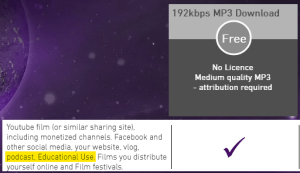
The licensing section of PurplePlanet, highlighting
the inclusion of podcasts in their free use policy.
It is also not well-advertised within City that staff have access to Adobe’s Stock repository, within which many elements are included either under Creative Commons licensing or Adobe’s Educational Licence. However, as mentioned above, it may still require a certain amount of digging on all of these sites to find specific elements which match all requirements.
I think it’s also necessary to ensure that staff are aware of City’s dedicated copyright librarian (Stephen Penton) and the City LibGuides Copyright microsite dedicated entirely to helping all university users (students and staff) navigate crediting, licensing and more. This is something I was not originally aware of when I first started and now use as a “cheat sheet” guide whenever I am creating a new piece of media.
It’s vital that we encourage staff to both get in touch and stay in touch with LEaD and the library when it comes to creating openly-licensed multimedia resources. I want to help establish and foster a collaborative and supportive environment amongst staff where no multimedia question is bad; where staff can stay up to date with changes in both copyright law and the latest mod-cons when it comes to creating, adapting and distributing resources; where staff can be proud of the multimedia resources they have worked on, and confident in distributing them to a wider audience thanks to their openly licensed elements.
The more we are able to create accessible, diverse, high quality multimedia resources which can be shared on a local and global scale, the more we broaden the size of our open, collaborative, educational community.
I have chosen to attribute the CC BY-NC-SA licence to this work. Ultimately this means that:
“re-users give credit to the creator. It allows re-users to distribute, remix, adapt, and build upon the material in any medium or format, for non-commercial purposes only. If others modify or adapt the material, they must license the modified material under identical terms.” (Creative Commons, 2024)
I chose this option as I am happy for others to use my work to build their own pieces, however I want them to continue in the spirit of Creative Commons’ ShareAlike licensing so that others can build on their work.
Directing teaching staff towards free, openly-licensed, easily-accessed graphics and audio to enhance their educational resources © 2024 by Emma Guilbert is licensed under Attribution-NonCommercial-ShareAlike 4.0 International