Nurse Education: encompassing open educational practice

This essay is by Sarah Wiggins who is a nurse educator and recently completed the module EDM122. She has licensed her essay under CC-BY and writes…

In recent years technology has developed and grown with advanced methods of education visible. There is global recognition that open education has been used in strategising education and teaching opportunities. This has paved the way to create pioneering changes that have proved to be effective within healthcare and education (UNESCO, 2019).

The scope of Open education encompasses the use of open access, open technology, open licensing and Open Education Resources. UNESCO (2019) defined Open Educational Resources (OER) as “learning, teaching and research materials in any format and medium that reside in the public domain or are under copyright that have been released under an open license, that permit no-cost access, re-use, re-purpose, adaptation and redistribution by others”.

An objective of Open Educational practice is demonstrated by making learning accessible and available to all by minimising the limitations of access to material. This provides an opportunity for teachers and students to develop by collaborating, building and sharing knowledge. The development and move towards OER has been driven by the need for inclusivity whereby distance education methods facilitate lifelong learning and the growing needs of the market.

As a registered nurse educator, lifelong learning is essential to maintaining high standards of care delivery (DOH, 1999). My perception of lifelong learning, the delivery of teaching and educational motivation has changed significantly in recent years. This is mostly related to the Covid-19 Pandemic where globally, changes had to be made. Education had to continue and within my role I had to find new and innovative ways to improve. Access to nursing education was of upmost importance and in light of this I understood that working collaboratively with learners and taking an open pedagogical approach would be appropriate in the evolution of change. (Petrovic et al, 2023). My use of open education practices has increased in recent years, hence the desire to reflect on this topic and not digital literacy. For the purpose of this assignment, I will focus on open education resources, open pedagogy and open technologies as these are appropriate to my style of teaching.

Open Education Resources

In nurse education open educational resources (OER) are widely used particularly within my role. This has become a revolution in the way teaching can be delivered in the 21st century.

The accessibility of OER makes it particularly useful as it is available to all staff by and can be accessed worldwide. The digital library contains educational materials which I have used within my role to support my teaching and provide education. The resources that I have used include journals, videos, pictures and open books. The educational materials I have accessed are released under Creative Commons (CC) licenses which allows the user permission under copyright law.

I deliver education to nurses and healthcare support workers under the umbrella term the Fundamentals of care. The methodology and educational resources I use in teaching vary slightly as I teach in house simulation and also use blended learning for other subjects. Generally, my teaching is delivered by a powerpoint presentation. The educational material I have used has come from open books and the latest evidence based practice. In particular subjects I have used pictures and videos to enrich my teaching practice and the learning experience of my nursing colleagues. For example, I have recently created an e-learning module about Mouth Care and I have included a short video which highlights the significance of providing oral care to patients and demonstrates the impact poor oral care can have on an organisation. The video was released under CC-BY and the creator of the video acknowledged allowing the credits for the author to be attributed. Using this method supports Wiley et al (2018) proposal of CC that the video can be retained and reused.

The e-learning module is available to all staff and can be accessed via a digital platform (Moodle) used in Barts Health NHS Trust (OECD, 2011). The benefits of using educational digital videos are recognised in a study by Rodríguez-Almagro et al (2021) who advocate that students can link the theory to practice, enabling the students to develop a better understanding of the subject. Another advantage I found is that I could adjust the content of the module to tailor to the needs of the target group (Weller, 2021).

Active teaching methodologies have changed and a method that is used widely in education have been introduced by the use of technology such as mobile phones. As my career in education progressed, combined with the impact of the Covid-19 pandemic, changes were made to adapt to the current climate. The use of enhanced technology was paramount to ensure healthcare professionals maintained their educational and professional development (Rodriguez et al, 2020). I have supported the use of mobile phones as students are able to log into a classroom using a Cat QR code where the attendance is recorded centrally. Staff were able to continue accessing resources that were designed specifically for purpose. The advantages of this are such that healthcare workers could download an App onto their mobile phone and use for educational purposes, patient care and access to various healthcare related systems. However, I had to ensure that open resources that were provided were safe to use and had a recognised CC license. The disadvantages of using OER for educational resources are the quality and safety assurance of the provider. Some apps may not give details of the producer and therefore prove to be unreliable (Ventola, 2014). An App that I encourage staff to use is IRESUS as I know it is produced by the Resuscitation Council and is a reliable source of open education with a CC license.

Moreover, equality and diversity are central to the pedagogy of an inclusive educational system. An inclusive approach embraced by Higher Education England (2010, P4) supported a larger diversity of students to access education. Within the NHS in the United Kingdom, and in Barts Health, diversity and inclusion are of paramount importance. The workforce consists of staff from varied cultural and ethnic backgrounds and this needs to be taking into account when planning and designing a curriculum. Barts Health welcome international healthcare professionals from countries such as the Philippines and India.  The use of OERs such as YouTube videos are particularly beneficial when teaching the Fundamentals of care. Bed baths are a fundamental aspect of care and who delivers this care this differs somewhat internationally.  In the UK, bed baths are provided by the healthcare professionals. In international countries personal care is provided by the family. Collaborative working, sharing and embedding OER into the design of teaching will not only provide the international nurses with a cultural competence, it is accessible and available to all (Breslin et al 2017; Cronin, 2017)

Open technologies

Wiley (2018) supports the notion that open pedagogy is connected to open educational resources which can be used to support learning and the open sharing of teaching practices to improve education and training at all levels. This highlights further how this practice demonstrates inclusivity as it is available to those at an institutional level, universities, professionals and individuals as a whole. The term “open” signifies this as the OERs are released under an open license which grant permission for everyone to contribute. This is reinforced by Wiley’s recommended 5Rs activities that are: “retain, reuse, revise, remix, redistribute”.

In everyday practice and working collaboratively with my team, we are always looking at ways to improve the delivery of teaching by using open technology. This derives from the reworkings that were made during the Covid 19 pandemic where classroom learning reduced and was replaced with blended learning. Skulmowski and Rey (2020) argue that the pandemic sped up the use of digital platforms and recognised that this will initiate change for the future. Those changes are visible today whereby nurses and other health professionals use mobile phones and laptops to gain access to educational material. The resources desired determined which hosting platform would be used. Twitter was commonly used and one of which my line manager favours. Twitter allows the user to showcase ideas for others to see or as a way to gain ideas. It encourages open communication and sharing of ideas with other staff within healthcare that I might not necessarily see every day. If I search further using a hashtag I can search different platforms and gain further information. I have used Twitter to share information on topics about mouth care and falls prevention. I have learnt to ensure that I use creative commons licensing when redistributing on a blog or other platform.

Open pedagogy

Clinton-Lisell (2021) define open pedagogy as practices that make changes to learning and teaching accessible by using content creation through an open license. However, there are many definitions and conceptions of open pedagogy that have encouraged my research on this. It is argued that open pedagogical practices have been proven to have a positive impact on a student’s learning. This is evidenced by students showing increased engagement, motivation and self-directed learning (Wiley et al, 2017; Dermody, 2019; Tillinghast, 2020). With this evidence in mind, in practice I need to determine what is open about open pedagogy and how do I conceptualise this? The word ‘open’ could mean such as open access, open teaching, science, the right to access and use according to Pomerantz and Peek (2016). My interpretation of this is aligned with Cronin (2017) conceptualisation that students can access education and resources free. Due to the movement of OER students are now able to contribute to open textbooks and can help to create a curriculum by sharing what they feel is necessary to meet their learning objectives.

An idea I would particularly like to try would be open pedagogy notebook based on the Fundamentals of care. The goal of the notebook would be based on the learning objectives of underpinning knowledge of the Fundamentals of care. My nursing colleagues could create a piece of work that would be used by healthcare professionals and the general public. The notebook could be divided into a few small chapters, each focusing on a different aspect of care.  Each nursing colleague could contribute to a chapter each based on their knowledge. A peer review shared amongst each other, possibly by each chapter, would enable the writer to gain a different perspective and give feedback. After a final review the book could be published. Advantages of this style of education are that learners are involved in making an educational change. Involving the learners will help to increase their critical thinking skills and encourage a collaborative style of learning. It will enhance their communication skills, boost their confidence, develop a deeper understanding of the fundamentals of care and empower them as learners. As an educator, I would need to ensure that have been taught about copyright, ensuring that they use Creative commons licenses that they are comfortable with.

To conclude, the changes bestowed upon us as a result of the Covid-19 pandemic have been unfound. The present and the future have been dictated by the movement of open educational practice. This has proven to have had a clear impact in nurse education and will continue to support the lifelong learning goals that a nursing career requires from you. Working through this module, has given me great insight into the cultural inclusion that open education practices permits, allowing access to all and new ways to actively involve learners in their own education. On reflection, I have found this module to be beneficial to me as an educator. It has given me scope to think of innovative and new ways to embed education encompassing open pedagogical practices, educational resources and technology. I would like to develop my skills using Creative Commons licensing and explore this further with learners. This is an objective I would consider for continued professional development in my nursing career.

References

  • Breslin, E. et al. (2018) The changing face of academic nursing: Nurturing diversity, inclusivity, and equity. Journal of Professional Nursing. 34(2), pp.103-109. Available at: (https://www.sciencedirect.com/science/article/pii/S8755722317303022) [accessed 28.01.23].
  • Creative Commons (2017) About the licenses. Available at: https://creativecommons.org/licenses/ [accessed 28.01.2023].
  • Cronin, C. (2017) Openness and praxis: Exploring the use of open educational practices in higher education.The International Review of Research in Open and Distributed Learning, 18(5), pp.15–34. Available at: https://doi.org/10.19173/irrodl.v18i5.3096 [accessed 28.01.2023].
  • Department of Health (1999) Making a difference-Strengthening the nursing, midwifery and health visiting contribution to health and health care. DOH, London.
  • Dermody, R. (2019) Open pedagogy for teaching structures. In Brause, C., Clouston, P.L. & Darling, N. (Eds.). Building technology educator’s society: (art. 3).University of Massachusetts. Available at:  https://doi.org/10.7275/s9xd-h436 [accessed 29.01.2023].
  • Kurelovic, E. (2016) Advantages and Limitations of Usage of Open Educational Resources in Small Countries. Available at: https://files.eric.ed.gov/fulltext/EJ1105180.pdf [accessed 21.01.23].
  • Organisation for Economic Cooperation and Development (OECD) (2007) Annual report. Available at: https://www.oecd.org/newsroom/38528123.pdf [accessed 21.01.2023].
  • Petrovic, K et al (2023) Aligning Nursing Ethics with critical and open pedagogy in nursing education: A literature review. Nurse Educator. Available online: https://pubmed.ncbi.nlm.nih.gov/35900936/ [accessed 15.02.2023].
  • Resuscitation Council UK. (2021) iResus: Guidelines on the go. Available at: https://www.resus.org.uk/library/iresus accessed [15.02.2023].
  • Rodríguez-Almagro, J. et al. (2021) The Impact on Nursing Students of Creating Audiovisual Material through Digital Storytelling as a Teaching Method. Available at: https://pubmed.ncbi.nlm.nih.gov/33467398/ [accessed 21.01.2023].
  • Romero-Rodríguez, J-M. et al. (2010) Mobile Learning in Higher Education: Structural Equation Model for Good Teaching Practices. Available at: https://ieeexplore.ieee.org/abstract/document/9094244 [accessed 27.01.23].
  • Skulmowski, A. and Rey, G.D. (2020) COVID-19 as an accelerator for digitalization at a German university: Establishing hybrid campuses in times of crisis. Behav. Emerg. Technol. 2, pp. 212–216. Available at: https://www.ncbi.nlm.nih.gov/pmc/articles/PMC7283701/ [accessed 29.01.2023].
  • Tillinghast, B. (2020) Developing an open educational resource and exploring OER-enabled pedagogy in higher education.IAFOR Journal of Education: Technology in Education, 8(2), pp.159–174. Available at: https://doi.org/10.22492/ije.8.2.09 [accessed 25.01.2023].
  • UNESCO (2019) Open Educational resources. Available at: https://www.unesco.org/en/open-educational-resources [accessed 15.02.2023].
  • Ventola, C.L. (2014) Mobile devices and apps for health care professionals: uses and benefits. Available at: https://www.ncbi.nlm.nih.gov/pmc/articles/PMC4029126/ [accessed 27.01.23].
  • Weller, M. (2021) Open educational resources offer promise for more equitable teaching and learning. Available at: https://www.bera.ac.uk/blog/open-educational-resources-offer-promise-for-more-equitable-teaching-and-learning [accessed 21.01.23].
  • Wiley, D. et al. (2017) A preliminary exploration of the relationships between student-created OER, sustainability, and students’ success. The International Review of Research in Open and Distributed Learning,18(4), pp. 61–69. Available at: https://doi.org/10.19173/irrodl.v18i4.3022 [accessed 25.01.2023].
  • Wiley, D. and Hilton, J. (2018) Defining OER-Enabled Pedagogy. The international Review of Research in open and Distributed learning. 19 (4) Available at: https://www.irrodl.org/index.php/irrodl/article/view/3601 [accessed 21.01.23].

This work is licenced under a Creative Commons attribution Licence CC-BY


Open textbooks, Covid-19 and the cost of living

An open book

Photo by Mikołaj on Unsplash

This is a guest post by Kathryn Drumm, written as part of her final assessment for EDM122 Digital Literacies and Open Practice 2022/23. Kathryn writes…

I was initially inspired to look the current use of open textbooks, how the pandemic accelerated their use, especially as a reaction to the changes in the prices of e-book licences supplied by major publishers, how they can help ease the effects on students of the cost of living crisis. Once I looked further into the area of open textbooks, and their relationship to other OERs (Open Educational Resources) I considered whether their use could also help to change how students create assessments.

In the spirit of openness, I wanted to see if I could research and write this essay using only resources that were openly available. I restricted my sources to those I could access via internet searches without going behind any paywalls. I used Google scholar and followed embedded links within references in journal articles. City Library’s website and catalogue is openly available, unlike some universities which only restrict access to their catalogue to registered users. It is also possible to add filters to restrict results to fully online and open access resources. When accessing the resources, I selected the option which directed me to a downloadable PDF or open access site, rather than accessing them via a journal which required me to sign in with an institutional login. I didn’t repeat the searches with the open access filter removed, and so I have no sense of whether I have been barred from accessing important sources. However, I may repeat the searches at a later date to compare the number and quality of resources returned.

The lockdowns of 2020 lead to universities closing their doors and, as with most of academia, pivoting to an online model. At City, the library sites were closed to students until a limited opening in July 2020. (City Library, 2020a) Instead, students were directed to online resources (City Library, 2020b).

As Anderson and McCauley (2022) note in their account of the #ebooksos movement, academic publishers initially responded to the crisis by making electronic books and journals available at no cost (Jisc, 2020). However, librarians soon noted that as the pandemic went on, this free access was withdrawn and in many cases, prices increased by 500%. (Fazackerley, 2021) Anderson and McCauley also noted the discrepancy between the cost of hard copy and e-book version of the same work, the e-book version beings as much as 4,000% more expensive. In what may be viewed as another form of openness, librarians collaborated online to share details of the usually confidential contracts, to expose the price rises and to lobby public bodies.

Having worked in the library, I was aware of the complex licensing arrangements that can govern access to e-books. There may be a limit on the number of times a book can be viewed or how many users can view it concurrently. It was a regular experience to be contacted by students who had had their access to an e-book terminated once the agreed number of views was reached, or for students to have to wait while another classmate used the book. Access to journals is often bundled and the terms of contracts can be changed with little or no warning.

While the physical constraints of the pandemic may not remain, many of the financial constraints on universities and students remain and may be increasing.The last Student Income and Expenditure Survey reported students spending around £500 per year on course materials. (Department of Education, 2018) In more recent commercial surveys, UK students report spending between £17 (Brown, 2022) and £35 (NatWest, 2022) a month on books and other course materials. As a survey commissioned by Universities UK found that two thirds of students were concerned about managing living costs, and that this may influence some to drop out of their studies (Universities UK, 2022) one could argue that this highlights how the idea of openness has always been tied to social justice and to opening education to all.

The start of the open access movement is often dated back to the early 2000s with the Budapest Open Access Initiative, the Berlin Declaration on Open Access to Knowledge in the Sciences and Humanities, and the Bethesda Statement of Open Access Publishing (Mering & Hove 2020). It is interesting to note that much as the current move towards open textbooks was caused by the Covid crisis, the original OA movement was triggered by a series of crises in the cost to universities of accessing journals.

Open access publishing falls under the broader umbrella term of Open Educational Resources, defined by UNESCO “learning, teaching and research materials in any format and medium that reside in the public domain or are under copyright that have been released under an open license, that permit no-cost access, re-use, re-purpose, adaptation and redistribution by others.” (UNESCO no date) Others have used the Five Rs definition by David Wiley of retain, reuse, revise, remix and redistribute. (Wiley, 2014)

However, there are still barriers to the uptake of open textbooks as OERS. Anderson (2013) notes the reluctance by some to include open access publishing in the same category as open learning objects, online videos, etc.

When viewing open textbooks through the prism of the five Rs of OERs, we may consider that using them to replace expensive commercially published e-books does not fully exploit their potential. Could revising and remixing the content of open textbooks create resources more closely aligned to individual courses. Harrison et all (2022) lament that the full potential of open textbooks has yet to be embraced and that they are still, “presented as a relatively static body of information, with the apparent intent that they be used in teaching in a manner similar to the traditional textbook.” They instead propose that educators and students co-create open textbooks. This would also incorporate another aspect of open education, by allowing for the content to be presented via multiple voices and viewpoints. In this way, students would also increase their digital literacy skills by having to assess the existing content within the textbook, and the content that they aim to add.

In my own role, the sessions that I run which introduce staff to Moodle, our virtual learning environment, emphasise the importance of abiding by copyright legislation when sharing resources (journal articles, book extracts, images) and working with the library to develop a reading list for students. Likewise, our online guidance on includes advice on using OERs and shares links of sources of OERs. However it does not contain guidance on how staff can make their own resources available as OERs, or revise them to suit their students. Educators know where their students need additional clarification and an open licence allows them to adapt the resource to support their specific students’ needs (Van Allen and Katz 2020) or can update them to keep them relevant. (Rolfe and Pitt, 2018 )

This leads also to the idea that open textbooks and other OERs could be adapted and revised by students as a means of assessment. After all, the current essay is most often a synthesis of previously published texts, with ideas and quotations remixed and reused by students. Could students create their own OERs, adapted from existing resources as an assessment? With the recent interest in the rise of AI generated essays and text, could this be combined with OERs to encourage student to learn how to adapt, improve and share existing texts?

The move towards authentic assessment as espoused by Boud and Falchikov (2006) proposes that students should be creating work in a way that mirrors the “real world”, whether we view that as the world of work or beyond. If we recognise that in future students will be working collaboratively, working with AI generated content and with openly available resources, then assessments which prepare them for this, and which build further the library of OERs may be the way forward. And what better way to demonstrate this than requiring that all such assignments are openly published on a blog under a creative commons licence which allows it to be further adapted and shared?

Licence

This blog is licensed under:
Creative Commons Attribution-ShareAlike 4.0 International License

References

Anderson, T. 2013, “Open Access Scholarly Publications as OER”, International review of research in open and distance learning, vol. 14, no. 2. Available at: https://doaj.org/article/06b258b6ed5a46128b063b8f5a2157ad (accessed 01/02/2023)

Anderson, Y. & McCauley, C. (2022) ‘How the Covid-19 pandemic accelerated an e-book crisis and the #ebooksos campaign for reform’, Insights the UKSG journal, vol. 35. Available at https://doaj.org/article/7f6aa60fe8c04e17a21095ba410dccb3 (Accessed 25/01/2023)

Brown, L. (2022)  Student Money Survey 2022 – Results, Save The Student!, Available at: https://www.savethestudent.org/money/surveys/student-money-survey-2022-results.html#spend (Accessed 31/01/2023)

Boud, D. & Falchikov, N. 2006, “Aligning assessment with long-term learning”, Assessment and evaluation in higher education, vol. 31, no. 4, pp. 399-413. Available at: https://www.researchgate.net/publication/255632613_Aligning_Assessment_with_Long-Term_Learning (accessed 01/02/2023)

City, University of London Library (2020a) Limited Library Services on campus, Available at: https://blogs.city.ac.uk/library/2020/07/15/limited-library-services-on-campus/ (Accessed 01/02/23)

City, University of London Library (2020b) Accessing law e-books Available at: https://blogs.city.ac.uk/library/2020/03/17/accessing-law-e-books/ (Accessed 01/02/23)

Department For Education (2018) Student income and expenditure survey 2014 to 2015, Available at: https://assets.publishing.service.gov.uk/government/uploads/system/uploads/attachment_data/file/693184/Student_income_and_expenditure_survey_2014_to_2015.pdf  (Accessed 30/01/2023)

Fazackerley, A. (2021) ‘’Price gouging from Covid’: student ebooks costing up to 500% more than in print’ The Guardian, 29 January. Available at: https://www.theguardian.com/education/2021/jan/29/price-gouging-from-covid-student-ebooks-costing-up-to-500-more-than-in-print (Accessed 15/01/2023)

Harrison, M., Paskevicius, M., Devries, I., & Morgan, T. (2022). ‘Crowdsourcing the (Un)Textbook: Rethinking and Future Thinking the Role of the Textbook in Open Pedagogy.’ The Open/Technology in Education, Society, and Scholarship Association Journal. Available at: https://pdfs.semanticscholar.org/6cda/c495c879b9f7002334fabbf8f388cb247279.pdf (Accessed 01/02/2023)

Jisc (2020) Sector pulls together to deliver unprecedented amount of e-textbooks to minimise impact of COVID-19. Available at: https://www.jisc.ac.uk/news/sector-pulls-together-to-deliver-unprecedented-amount-of-e-textbooks-01-apr-2020 (Accessed 31/01/2023)

Mering, M. & Hoeve, C.D. 2020, “A Brief History to the Future of Open Access”, Serials review, vol. 46, no. 4, pp. 300-304. Available at: https://web.p.ebscohost.com/ehost/pdfviewer/pdfviewer?vid=0&sid=c7881165-08cd-406f-9373-7fc77c74dd37%40redis (accessed 01/02/2023)

NatWest (2022) Student Living Index, Available at:  https://www.natwest.com/content/dam/natwest/personal/life-moments/documents/NatWest_Student_Living_Index_Survey_2022.pdf (Accessed 29/01/2023)

Rimmer, W. 2020, “Responding to the Coronavirus with Open Educational Resources”, International Journal of TESOL Studies, vol. 2, no. 2, pp. 17-31. Available at: https://pdfs.semanticscholar.org/430c/5b894742f9fa50631aa66a65bb0a20d8bf48.pdf Accessed 01/02/2023

Rolfe, V. and Pitt, B., 2018. ‘Open textbooks – an untapped opportunity for universities, colleges and schools.’ Insights, 31, p.30. DOI: http://doi.org/10.1629/uksg.427

UNESCO (no date) Open Educational Resources Available at:  https://www.unesco.org/en/open-educational-resources?hub=785 Accessed 01/02/2022

Universities UK (2022) Don’t overlook students in cost of living crisis, say university leaders Available at: https://www.universitiesuk.ac.uk/what-we-do/creating-voice-our-members/media-releases/dont-overlook-students-cost-living (Accessed 31/01/2023)

Van Allen, J. and Katz, S. (2020), “Teaching with OER during pandemics and beyond”, Journal for Multicultural Education, Vol. 14 No. 3/4, pp. 209-218. https://doi.org/10.1108/JME-04-2020-0027

Wiley, D (2014)  The Access Compromise and the 5th R Available at: https://opencontent.org/blog/archives/3221 accessed 01/02/2023

First Webinar on Digital Literacy, Copyright and Creativity

Chris at CC Summit by Sebastiaan ter Burg2

On Tuesday 27th October at 11am the first webinar for the module EDM122 Digital Literacies and Open Practice will take place. This session is being delivered by Chris Morrison who is the Copyright, Licensing and Policy Manager at the University of Kent. Chris and I run the website copyrightliteracy.org and he is the creator of Copyright the Card Game and co-creator of The Publishing Trap, our game of open access and scholarly communication. Together we also run a regular webinar series on Copyright in a Time of Crisis, hosted by the Association for Learning Technology. We also have a fun podcast series called Copyright Waffle. Oh and we have a collection of novelty copyright t-shirts. No doubt Chris will be wearing one next week!

The webinar topic is based on a chapter that Chris wrote in the book Digital Literacy Unpacked edited by Katharine Reedy and Jo Parker. Chris’s chapter is available on open access in the Kent Academic Repository.

If you are not formally enrolled on this module and wish to book a place on the webinar then please complete the form to book your place. A link will be sent to you ahead of the webinar, with the joining instructions.


Slides and recordings now available from two webinars!

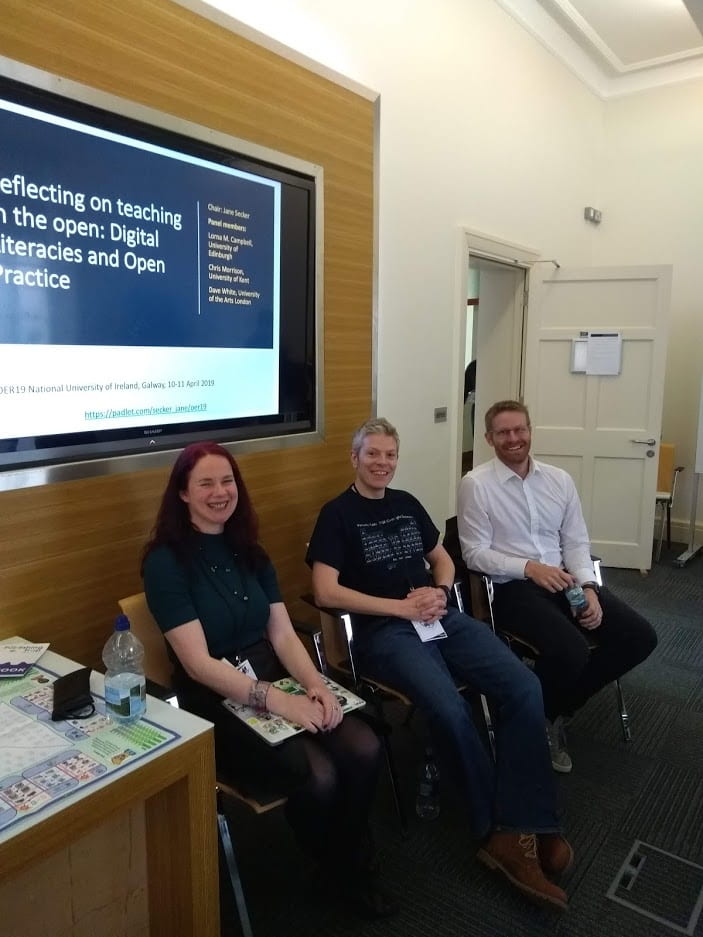
Lorna Campbell, Chris Morrison and Dave White presenting with me at OER19, Galway.

I’m really grateful to our first two webinar presenters, firstly Chris Morrison for giving our first webinar as part of the module last week on Copyright, Digital Literacy and Creativity. We also had a fascinating overview of the open education practices and policy at the University of Edinburgh from Lorna Campbell this morning. I’ve just made the slides and recordings available from both sessions. Here is Chris’s slides and recording and Lorna’s slides and recording.

There were quite a lot of really complimentary themes in the two webinars so they are well worth watching as a pair. Teaching people about copyright, licensing and Creative Commons is an important part of the open education approach adopted at the University of Edinburgh. Meanwhile, Chris is in a different role, but the University of Kent are in the process of creating a Copyright Literacy Strategy which will be used to guide both staff and students. Sometimes people need nudges towards particular behaviours and so this was an interesting theme in both presentations.

We had a fascinating conversation at the end of Lorna’s webinar about how effective the open education policy has been and what might indicate impact or success – their policy was created 5 years ago now. She talked about an increasing number of staff who are creating blogs, and also around a dozen examples of courses using Wikipedia editing as part of a summative assessment for students. Using Wikipedia is often not encouraged, particularly in schools and having a Wikipedian in resident has really started to shift attitudes at Edinburgh.

Chris was able to share some recent research he did into academic perceptions of copyright and also his masters research into how universities are interpreting the exception known as ‘illustration for instruction’ since the review of UK copyright law in 2014. Inevitably Brexit came up, as well as developments in Europe including the controversial Digital Single Market directive. Thank you to both my presenters, who also joined me earlier in the year at the OER19 conference (along with Dave White) to share their experiences of being part of this module.

First webinar on Digital Literacy, Copyright and Creativity

Chris at CC Summit by Sebastiaan ter Burg2

Tomorrow (Tuesday 22nd October) is the first webinar for EDM122: Digital Literacies and Open Practice taking place from 2-3pm (GMT). It will be delivered by my research partner Chris Morrison, who works at the University of Kent as the Copyright, Software Licensing and Policy Manager. Chris’s webinar is entitled ‘Digital Literacy, Copyright and Creativity’. He will be referring to the chapter he wrote last year which featured in the course text, Digital Literacy Unpacked by Jo Parker and Katherine Reedy. Chris’s chapter is available on open access in the Kent Academic Repository. He also recently completed his master’s in Copyright Law at Kings College, London and his dissertation focused on university’s interpretation of Section 32 of the Copyright, Designs and Patents Act, which is the exception for ‘Illustration for Instruction’. His full thesis is also available online and he will briefly summarise some of his findings during the webinar as well as talking more broadly about the concept of copyright literacy and why it’s important to understand copyright as part of digital literacy.

I’m really delighted that Chris has agreed to give a webinar again and this session will be recorded but you can join live to ask questions (access for guests does not require a log-in or password) to the Adobe Connect Classroom that I have set up.

Kicking off Digital Literacies and Open Practice 2019-2020

Photo by Leyre Labarga on Unsplash

I’m delighted that this module kicks off again on Thursday 17th October with a new cohort of keen participants. This year the module has also been offered to LIS Students at City and a few have opted to take the course, so they will be joining students on our MA in Academic Practice. I’m really looking forward to having their perspective and contributions. The one thing I really liked last year was allowing people to focus on the aspects of digital literacy and open practice that really appealed to them and to dig into the literature to inform their thinking. You could probably base an entire module on each concept, so trying to cover everything is really difficult, but I found myself wanting to add in more to my teaching materials and not take anything out when reviewing the slides last week!

Feedback last year for the module was really positive, so the pressure is on to keep the standard as high as before. I’ve had a really useful chat with colleagues Sam Aston and Chris Millson at University of Manchester, who teach their module Open Knowing in Higher Education. It was being invited to give a guest workshop as part of their module that really inspired me to create this module, so I hope I have been able to share some of my ideas with them as well.

I’ve also been overwhelmed with the support I’ve received from external colleagues who agreed to once again give up their time to be part of the webinar series. The webinars are open to everyone and the first of these will be on Tuesday 22nd October and given by copyright games enthusiast and policy expert Chris Morrison from the University of Kent – I’ll share a link to the Adobe Connect classroom next week on the blog again but here it is.

The full line up of webinars are on the website now and also you can still access the recordings from last year if you missed them. I’m using the hashtag #CityDLOP if anyone wants to tweet about the module and I have just about got my Moodle site up and running. So wish me luck!

Webinar now available: an introduction to copyright literacy

This morning was the first webinar for Digital Literacies and Open Practice and I was delighted to be joined by my co-researcher and good friend Chris Morrison, who is the Copyright, Software Licensing and IS Policy Manager at the University of Kent. The recording and slides are now available. Chris recently published a chapter on copyright literacy in the book Digital Literacy Unpacked, edited by Jo Parker and Katharine Reedy and published by Facet Publishing.

Chris provided an excellent overview of what copyright literacy is, how it relates to digital literacy and open practice and highlighted some of the work we’ve done in this area. He highlighted the resources on the Copyright Literacy website as well as recommending the site Copyrightuser.org. Chris also answered questions from participants on a range of topics.

The next webinar will be on Thursday 8th November at 3.30pm and will be led by Lorna Campbell from the University of Edinburgh. I’ll post more about the next webinar soon.

Webinar 1: An introduction to Copyright Literacy

Jane and Chris at CopyCamp2018

Next Friday 26th October we have our first webinar for Digital Literacies and Open Practice. Based on the chapter in Reedy and Parker’s Digital Literacy Unpacked, Chris Morrison who is the Copyright, Licensing and Policy Manager at the University of Kent will talk about the concept of copyright literacy. Chris and I have worked together since 2014 on research into different aspects of copyright and it’s impact of those working in libraries, the cultural heritage sector and in higher education. We’ve also developed several educational resources to teach people about copyright is accessible ways, including Copyright the Card Game, which you can play at City University on the 2nd November, and the Publishing Trap, which is a board game about scholarly communication and publishing choices. We will be playing this game on the final teaching day of the module on 12th December.

Tune in to the webinar live to join in the discussions with Chris, or you can watch the recording which we’ll post online shortly after the event (Guests are welcome, please drop me a line if you want to take part). The webinar will be an ideal time to ask those tricky questions about copyright (e.g. what is the difference between fair use and fair dealing, or who owns my recorded lectures or teaching materials!) You can also discuss how understanding copyright might help us become more open in our approaches to teaching, learning and research and how it’s all part of developing our own and our students’ digital literacies.