About Jane Secker

Associate Professor in Educational Development at City, University of London

First webinar on Digital Literacy, Copyright and Creativity

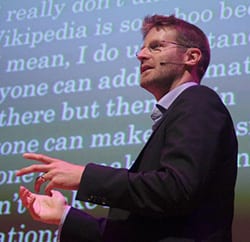
Chris at CC Summit by Sebastiaan ter Burg2

Tomorrow (Tuesday 22nd October) is the first webinar for EDM122: Digital Literacies and Open Practice taking place from 2-3pm (GMT). It will be delivered by my research partner Chris Morrison, who works at the University of Kent as the Copyright, Software Licensing and Policy Manager. Chris’s webinar is entitled ‘Digital Literacy, Copyright and Creativity’. He will be referring to the chapter he wrote last year which featured in the course text, Digital Literacy Unpacked by Jo Parker and Katherine Reedy. Chris’s chapter is available on open access in the Kent Academic Repository. He also recently completed his master’s in Copyright Law at Kings College, London and his dissertation focused on university’s interpretation of Section 32 of the Copyright, Designs and Patents Act, which is the exception for ‘Illustration for Instruction’. His full thesis is also available online and he will briefly summarise some of his findings during the webinar as well as talking more broadly about the concept of copyright literacy and why it’s important to understand copyright as part of digital literacy.

I’m really delighted that Chris has agreed to give a webinar again and this session will be recorded but you can join live to ask questions (access for guests does not require a log-in or password) to the Adobe Connect Classroom that I have set up.

Kicking off Digital Literacies and Open Practice 2019-2020

Photo by Leyre Labarga on Unsplash

I’m delighted that this module kicks off again on Thursday 17th October with a new cohort of keen participants. This year the module has also been offered to LIS Students at City and a few have opted to take the course, so they will be joining students on our MA in Academic Practice. I’m really looking forward to having their perspective and contributions. The one thing I really liked last year was allowing people to focus on the aspects of digital literacy and open practice that really appealed to them and to dig into the literature to inform their thinking. You could probably base an entire module on each concept, so trying to cover everything is really difficult, but I found myself wanting to add in more to my teaching materials and not take anything out when reviewing the slides last week!

Feedback last year for the module was really positive, so the pressure is on to keep the standard as high as before. I’ve had a really useful chat with colleagues Sam Aston and Chris Millson at University of Manchester, who teach their module Open Knowing in Higher Education. It was being invited to give a guest workshop as part of their module that really inspired me to create this module, so I hope I have been able to share some of my ideas with them as well.

I’ve also been overwhelmed with the support I’ve received from external colleagues who agreed to once again give up their time to be part of the webinar series. The webinars are open to everyone and the first of these will be on Tuesday 22nd October and given by copyright games enthusiast and policy expert Chris Morrison from the University of Kent – I’ll share a link to the Adobe Connect classroom next week on the blog again but here it is.

The full line up of webinars are on the website now and also you can still access the recordings from last year if you missed them. I’m using the hashtag #CityDLOP if anyone wants to tweet about the module and I have just about got my Moodle site up and running. So wish me luck!

Slides and recording from Catherine Cronin now available

The slides and recording from today’s webinar on critical digital literacies, data literacies and open practice, given by Catherine Cronin are now available. I was really thrilled that Catherine agreed to give our final webinar in the series, because of how important her work on open educational practices has been. Catherine and I have a lot of shared interests and she is going to be Co-Chair of the OER19 Conference, which is taking place in Galway Ireland in April. I will be seeing her then, as I have had a paper accepted to discuss my experiences of running this module, and I am delighted that three of my webinar presenters, Chris, Dave and Lorna are hoping to join me to share their reflections.

The slides, a recording and a set of resources from Catherine are available. Thank you to everyone who joined the recording. We did have a couple of technical issues, with Catherine not being able to hear me, so we used the chat box. It just goes to show that there is no such thing as digital competence, even for those of us who think we are fairly good at this stuff! And Catherine’s advice at the end of our chat with me, was you just have to keep dancing! I hope you’ve all enjoyed these webinars and this one is a real treat! Thank you to all my webinar presenters – there is now a full list of them on the webinar page.

Catherine Cronin webinar on Critical digital literacies, data literacies, and open practice

I’m delighted to announce that on Friday, January 11th, 12-1pm we have the final webinar as part of the module EDM122. The webinar will be given by Catherine Cronin, Strategic Education Developer at the National Forum for the Enhancement of Teaching & Learning in Higher Education in Ireland. 

Catherine tells us…..

As educators in an increasingly digital, networked culture, we are called upon to do a herculean range of things: manage our digital identities, assess a never-ending range of digital tools (and master at least some of them), understand copyright and open licensing,  

publish openly, share openly, and not least, manage the continually evolving risks of all of these activities. And we support our students in doing the same. Open educational practices can provide powerful ways for us to improve educational access, enhance learning, and empower learners  — but openness is not a panacea. The heart of all approaches to open education and open practice should be to develop critical digital (and data) literacies and to foster agency on the part of all learners and educators regarding whether, how, and in what contexts they choose to be open.

Open Education, Open Questions. EDUCAUSE Review, 23 October, 2017.

You can follow her on Twitter: @catherinecronin and her website/blog: http://catherinecronin.net/

The webinar is open to all and available in Adobe Connect, with no password required.

Embedding digital literacies in the curriculum: a webinar by Jo Parker and Katharine Reedy

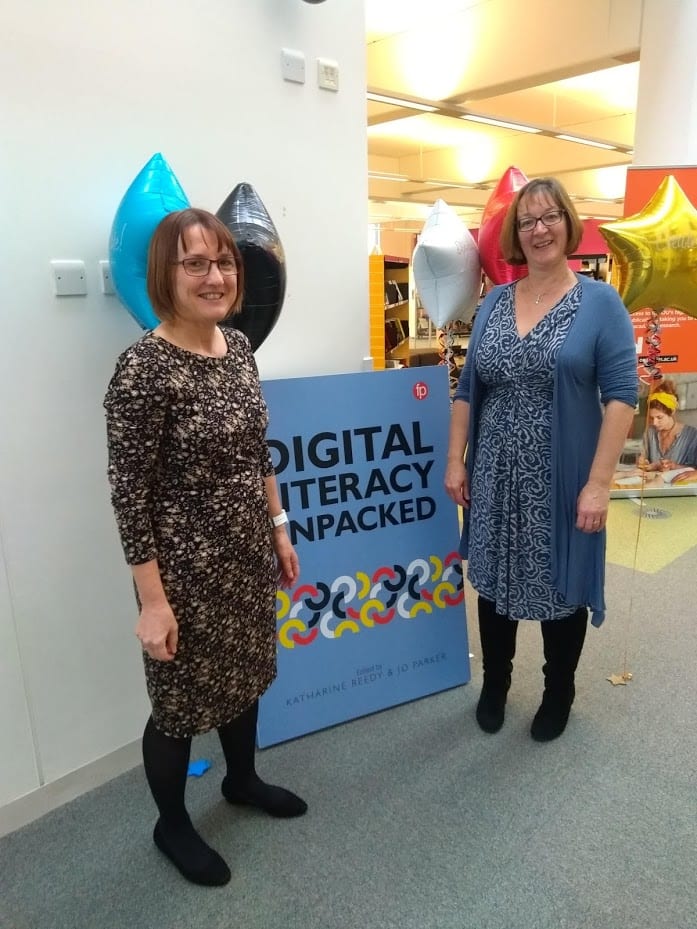
Katharine and Jo at the book launch for Digital Literacy Unpacked

I was really delighted to host a webinar this afternoon by the editors of one of the key books recommended for the module, Digital Literacy Unpacked published by Facet. Jo and Katharine focused on the topic ’embedding digital literacies in the curriculum’ based on their experiences at the Open University. A recording is now available and their slides.

We are going to be discussing this topic next week in the final teaching day which takes place next week on 12th December. We will also be looking at some of the tools the OU have developed to help course teams when they are planning a new programme or reviewing the content in a programme. One thing to consider is embedding digital literacies throughout an entire programme, not just individual modules is clearly an extensive piece of work. But it’s something really important and there are plenty of tools available to help you.

Next week we are going to also look at some of the tools from Jisc largely inspired by this blog post on Designing for Digital Literacies, written by Helen Beetham. Thanks to Katharine and Jo for the webinar today which is the final one this year. However, not the final webinar in the series as I am delighted to have one led by Catherine Cronin on the 11th January 2019 to conclude the series!

Networked values in hierarchical contexts – webinar by Dave White

I was delighted to host two webinars this week, the second which was given by Dave White, Head of Digital Learning at the University of the Arts, London. A recording of the webinar is now available and the slides.

Dave’s work on Visitors and Residents has been explored as part of this course, as a way of reconceptualising how we think about our relationship with technology. It’s also a different way of thinking about the now debunked notion of Digital Natives and Digital Immigrants.

In the webinar Dave talked to us about Networked value in Hierarchical Contexts and there were some great opportunities for participants to take part in online activities using a Padlet, which worked really well. Dave drew on the work of George Siemens and Stephen Downes on Connectivism. I was really interested in the work he has been doing recently at the University of the Arts around Open Values and this blog post provides an overview of his work and thinking to date. I’m excited to see that Catherine Cronin was involved in the work, as she will be giving a webinar to us in January.  Once again we saw a lot of connections between the two themes of the module and I hope people will enjoy watching the recording from this session.


Jisc Digital Capabilities by Sarah Knight and Lisa Gray

Jisc Digital Capabilities

I was grateful to reconnect with Sarah Knight from Jisc, who joined me for a webinar with her colleague Lisa Gray yesterday to talk about the Institutional Approach towards Digital Literacies. The recording is now available and their slides. It’s interesting to see how Jisc have developed their thinking about supporting and developing both staff and student digital capabilities and how the partnership model is still an important way of supporting this.

I was also interested to hear about the Community of Practice they have set up and the meeting held at the University of Hertfordshire this week. You can find out more about the community by subscribing to their Jiscmail list. We have been using the free Jisc Digital Capabilities Discovery Tool on the module, but there are a number of features available in the subscription version that looked really interesting. Thanks for Sarah and Lisa for joining us and I hope to join them at their next event in May to share some of the ideas we have been developing on this module.

Webinar on Digital Capabilities from Jisc

Jisc Digital Capabilities

I’m delighted that tomorrow afternoon from 2-3pm I am hosting a webinar from Sarah Knight and Lisa Gray from Jisc on developing an institutional approach to Digital Capabilities. Jisc have done a huge amount of work in this area, developing a framework and various tools to help support institutions developing both staff and student digital capabilities (or literacies as I tend to call them). Tomorrow’s webinar will be hosted in Adobe Connect and is also open to guest who can join the classroom online. There is a password on the room which is DLOP for anyone wishing to take part. There will also be a chance to ask Sarah and Lisa questions at the end and the webinar will be recorded and made available on the blog afterwards.

Slides now available for Lorna Campbell’s workshop

Lorna Campbell. CC-BY-SA-4.0, Mike Peel, Wikimedia Commons

We had an excellent webinar yesterday with Lorna Campbell from the Open Education team at the University of Edinburgh about open education practices. The slides are now available and there is a recording from the webinar. We had some interesting questions from participants and I’m really grateful to Lorna for an excellent introduction to some of the key concepts we are discussing on our second teaching day, which takes place on Wednesday 14th November. I’d really recommend you read Lorna’s blog post about open practices as well on the Soul of Liberty: Openness, Equality and Co-creation.

Webinar on open education from Lorna Campbell

Lorna Campbell. CC-BY-SA-4.0, Mike Peel, Wikimedia Commons

I’m delighted to announce that the second webinar being run as part of the Digital Literacies and Open Practice module will be taking place on Thursday 8th November from 3.30-4.30pm GMT. It will be given by Lorna Campbell, from the University of Edinburgh and is entitled ‘Open for all? Engaging with open education practice at the personal and institutional level.‘ Once again it will be in Adobe Connect and is open to guests if you drop me a line beforehand. We will also be recording the session and I will share the slides and recording afterwards for those who can’t join us live.

I read Lorna’s blog post on the Soul of Liberty: openness, equality and co-creation earlier in the year. It is based on a conference keynote that she gave, and it really moved me. I had already thought that open practice was important, but she explores a whole range of issues including the inevitable starting point, of what we mean by open, what open educational resources are. However the most important point of the post for me is the section that is entitled Inclusion, Exclusion and Structural Inequality. Openness is about things being free, and reducing costs, but it’s also about trying to address inequalities in education. Inequalities are all around us; who has power, who gets access to knowledge, who’s voice gets heard and it’s such a powerful part of the open movement, to try and redress that on many levels. I am really looking forward to Thursday and I hope that some of you will join us!